All That I Hold Dear

Postcard from St.Kilda

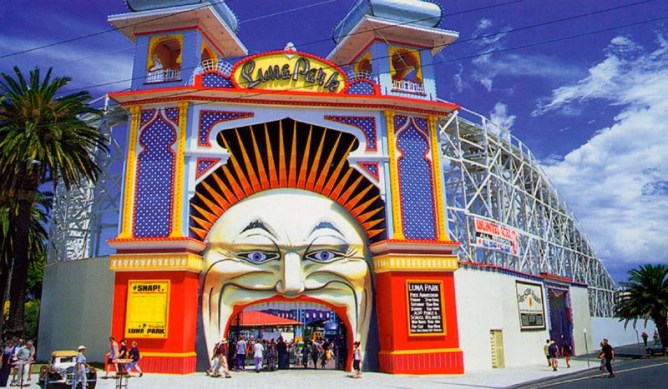
I am going to Armenia. Say goodbye to the dundun ding ding of the Carlisle St trams and their electric hum and steel track and grit as they rattle down to Luna Park. To dinners with my daughters on Acland St at Greasy Joes or Chinta Ria or Ricocco and one glass of wine too many and talking of family and philosophy and plans in certain and uncomplicated ways that makes the world seem small and manageable and simple and just waiting for the last few puzzle pieces to get into place before that becomes that and we solve marriages and boat people and what to say to others so they will know us and value us and things can be worked out. And to old Port Phillip Bay with broken oyster shells in the shallows thrown by aboriginal peoples over tens of thousands of years of eating cold salty raw flesh and where I first learned to swim at the sea baths in Brighton at my Dads insistence on cold cold mornings in syrupy sea specked with seaweed flakes. And I can still smell the dried seaweed of that place. And the swim teacher Miss Finlayson assumed my polio leg would hold me back so she spent a year teaching me to dog paddle until I could dogpaddle into the sunset and back.

I have packed the rooms of my house into boxes and bubble wrap and some has gone into storage but most has been shipped to Armenia. It goes through the Suez Canal, into the Mediterranean, then into the Black Sea to the Georgian port of Poti and by road to Yerevan. It will reach there in 12 weeks. I spent days struggling over what to keep, old china Donald Duck egg cups given at Easters by my loving parents 50 years ago, paintings my daughters made, two decades ago when they were three and five, so many things like locks of lovers hair, worthless to others but hard to discard even now. I labelled what was to be shipped, what was to be stored and what was to be left for me to sort and give to the Salvos or throw. But the moving crew on the second day was different to the first and now apparently kitchen drawers full of rubber bands and old tap washers, blue tack and string and the futon bed from my spare room that I was going to sleep on this last week while I clean up and then store with it my Mother and so I have a bed to sleep on at Christmas time….have gone in the container to Armenia with who knows how much other junk. And what am I going to do with all that stuff in Yerevan, except puzzle the garbage men with buckets of trash from the other side of the world.

So the next few days I am camping in my empty place to spend some days scrubbing out the memories of 10 years that have found their way unnoticed, brown and sticky into the corners, dry crusty rusted shapes on lino and stains on the walls and cupboards. There is ageless lonely dust and fluff mixed with the hair of my former girlfriend and cotton thread, tumbleweed messy on the polished boards. In the clutter of my life and all the busyness I never noticed I was living among all these hidden marks and stains.

With my futon bed gone I bought a Coleman airbed at Rays Outdoors and it is so big I got a Coleman plug-in electric pump, it has enough power to inflate a zeppelin. And now I am sitting on the airbed which is tight as a drum and in front of me on a blue plastic crate table covered with my last tea towel, a refugee from the packing, Indian take out, a flimsy white plastic fork and a coffee mug of wine. I didn’t really think through the living-in-an-empty-apartment-to -clean-up-before-I -leave part with enough clarity. I can’t imagine how I thought a microwave and a cup was enough to survive for a week. I guess it is because my mind had so much on in getting ready I only thought to this point. Still I am surprised by how little I need to live. Two full trucks of stuff from my life gone and I don’t really miss it. And I am wondering how much of what I have and what I do is really necessary. Between TV adverts, spicy curry and red wine, I am thinking there is another lesson here somewhere.

I am on leave but still taking care of some loose ends here and there and preparing for my work in Armenia. I Skype a friend, asking if he will be available in September to do some training in Eastern Europe. He is stuck in Italy after a motorcycle accident which left him with seven broken ribs. The doctors s told him he can’t fly back to his home in South Africa yet as a rib might re-break and puncture his lung. His wife has joined him in Italy but his three kids are home in Durban.

A day later he Skypes me back.

Jock I don’t know what to say. This is a month of disaster. Last night my daughter passed away in an accident falling from a balcony at her 21st birthday party. I cannot tell what my September movements will be. I want to thank you for the opportunities that you have given me. I want to continue to work with you. But I must get over this issue with my family.

I leave the day after tomorrow and won’t see my kids for six months. One of my daughters calls me and wants to chat and nothing now is more important than she and I having lunch at the Galleon in an hour, whatever we talk about. And the trams outside on Carlisle St go dundun, ding ding as we talk.

Posted in Postcards | Tagged , | Leave a comment

Riding on Trust

Postcard from Hanoi

I am free falling, no escape. My head in my hands, panic somewhere just below where my heart should be. I tell myself I have been to this place before and so far it has always ended alright but right now I am finding this hard to believe.

I have come to Hanoi to deliver some training to our local staff to share insights and approaches that will help them to make market systems work better for farmers who are poor. Last week was a busy one in the office, mind numbing and endless bureaucracy and meetings and I didn’t, I couldn’t immerse myself, go deeply into the material and now I am trying to and I realize don’t know what anything is. I am sure I have nothing to teach that will matter to anyone, no wisdom that will transform anything, nothing I can think to say that is worth more than a glass of water and a look up the road. I wonder about faking it but don’t think I can do this over two solid days of training. I don’t know if I am authentic or not but I know I don’t have the energy to intentionally fake anything these days.

I am bringing myself only; for some time I have seen how to do my work like one of those clever optical pictures, now you see a witch and now you see the beautiful woman. At this moment all I can see is the witch. Like the spectrum where there is a line with realism one side and optimism on the other, and just a little to the left of realism is pessimism and just a little to the right of optimism is bullsh*t and I don’t know what the middle is called, nor does it seem that there is any rest for me there. I feel called to the emergence of spirit and don’t how that fits into systems and donors and organisational structures.

I have four PowerPoint presentations open on my computer, great work, dozens perhaps hundreds of hours in the making, well thought through, well constructed. The total number of slides is three hundred and three. That is an average of one slide every 6 minutes for 5 days. I have two days. So I do the only logical thing, I think which slides are not absolutely necessary to give a thorough two day competency course on ‘markets development’? And that brought me to the place that I am at this minute with my head in my hands.  I reduced the slides from three hundred and three slides to zero; I couldn’t find anything that I thought was absolutely essential in the slides to doing the work in the field. So here I am in Hanoi, it took me about 16 hours to get here and I don’t have anything that seems useful to tell anyone about.

I went for a walk this morning, this whole place is buzzing, everyone seems intent on something and every square metre of real-estate, footpath and roadway is crackling like a hot wok. What do I possibly have to tell anyone here about anything to do with business? Someone’s quote ‘the wisdom of the community always exceeds that of the experts’, sounds right to me. Maybe I can help them see things that will make a difference. Yeh right.

Four days have passed, three very of them in the countryside north of Hanoi being shown activities of farmers by enthusiastic staff watched over by government minders and sometimes snake eyed, vacant faced secret police and me watching the interactions of our staff, who I know will be attending the workshop on Thursday.

Its Thursday and I am in the conference room of a two star hotel, the room smells of stale tobacco and soy sauce, twenty expectant faces waiting for me to impart knowledge and wisdom that will change their lives and the communities they work in. The data projector at my table is humming and I turn it off. There are worried looks, I sense here that training with no PowerPoint’s will be like a meal with no rice. So I say, don’t worry I have over 300 PowerPoint slides and you will all get them before I finish. There is relief and smiles.

Once upon a time there was a village where the people were starving and no one knows what to do. The chief of the village summons the strongest young man and says “Go over the mountains, find the wise Oracle and bring her to us, she will tell us what we need to do”. So the young man sets off and after much hardship and many weeks he finds the Oracle and brings her back to the village.

The Oracle asks, so i am here, what is the problem? And the villagers reply, “Great Oracle we are starving!” and the Oracle asks them “So what is the answer to your problem?” and the villages stare at each other in confusion and one brave villager replies “We are starving and don’t know the answer to the problems in our village, that is why we sent for you so that you can tell us the answers.” And the Oracle replied, “If you don’t know the answer I won’t be able to help you”. And slowly she stood up, picked up her walking staff without another word began the trek back over the mountains to her home. Some months went by and the chief consulted with the elders and they agreed, they would send for the Oracle again to seek her wisdom and this time when she asked if they knew the answer to their problems, half the village would say they knew the answer and the other half would say they didn’t and in this way they would elicit the answer from the Oracle to what they should do to save themselves.

So again the brave young man was sent to beg the Oracle to visit again and she consented and together they slowly made the journey back to the village of hungry people. And again she asked if they knew the answer to their problems. And as they had agreed, half the village said that they knew the answer and half the village said they did not know and they asked the Oracle what they should do. The Oracle thought for a moment and then said “Those who know the answer tell those who don’t know.” And then she took her walking staff and without another word left the village.

That night that the chief had a dream and then next day he called everyone together. And he said, “The Oracle did in fact give us the answer, but we didn’t have the ears to hear it. The answer is that the solution to our problem lies within us, because we can only respond to things we already know to be true. If they were beyond our comprehension we could not respond, so anything we can do is within our comprehension so the answers to our problems are already within us.”

And so I told this story. And then I said, market development is easy, first you find out what buyers are buying, then you find out what people are producing, after that you try to figure out how the market might work better for producers so that can get more for their products. And this is generally by assisting producers to buy inputs better or to supply more of what the market is demanding or increase their bargaining power by selling collectively. Then you work together innovate what seems to be working so that you can maximise whatever successes have emerged and you watch and talk and then try communicate what everyone has been doing and learning to as many producers as possible. As more producers become involved you offer your support and share experiences about what has been effective within the value chains they are part of. And at various times you take a step back to see what the impact has been and what can be learned for the future.

And everyone agreed that they knew this already and that it was helpful when it was spoken so simply. And so I said the answer is already with you. And the answer is in the communities you work in, and you must be the Oracle to them. Just as I must be the Oracle to you. And I am thinking about the belief in the power of the other, the respect and valuing and what kind of organisational structures might sustain this better.

And people nod and faces are expectant and still hungry so I remind everyone that I have 300 slides.

Once upon a time there was a traveler who walked several days without food and arrived at dusty village. Two rows of cylindrical, mud walled grass thatched huts each side of a dusty dirt track. It was hot in the early afternoon and the village smelled of charcoal fires and cow dung. The villagers sat in slithers of shade on split logs pressed hard against the walls of the huts or squatted in the pools of of shade under the few trees in the central common near the Well. The flies were thick and tried to find moisture in corners of the kid’s eyes and mouths. And into this village the hungry visitor came. And to the first person he said, I am hungry can you spare a few mouthfuls of food. But the villager said “We are too hungry uncle and no one here has any food to spare.” And at the second hut and the third the villagers said the same. The visitor rested a while under one of the trees and in the cooler part of afternoon he went to where Well was and spoke in a voice loud enough to be heard through the whole village. “I see everyone is hungry, and so am I make a big meal and feed everyone, please come and join in the feast, this evening we will all eat well.”

The visitor asked for the biggest pot in the village and someone brought it, he asked for some fire wood and the kids collected what they could. And the man filled the huge pot with water and put it on the fire. And when the water was boiling he took out a large polished stone from his bag and announced. “I will now make stone soup!”

After some time the visitor took out a spoon from his bag and took a mouthful of the steaming liquid. “Ah it is coming along well, I think it just needs a little salt, can anyone spare a little salt?” and someone brought some. And the pot bubbled and the villagers chatted amongst themselves and waited expectantly. And the visitor again tasted the liquid. “Oh wonderful” he said, “Its coming along well, all we need are one or two onions, can anyone help with two onions?” and these were supplied. And so the soup bubbled and every so often the visitor would taste the broth ask for one more ingredient, one time carrots, the next potatoes, and the next some chilli and the next some maize and finally a chicken. And when the soup was ready everyone had more than they could eat and there was plenty left over.

And so I asked the people in the workshop, what do you think this story about? And someone said, “It shows how when everyone works together there can be more than any one person working alone.” And everyone nodded. And I asked what else? And someone said “The traveler had to trust and believe that the villagers had it within them to respond, otherwise all they would have had was hot water with a rock in it and the visitor would have to run for his life. “

And that to me is the is the wonder of this story, that a visitor to a community would be prepared to risk himself or herself not based on a belief that their job was to be an expert or to own a success but to take a risk that other could be shown they have the answer. To have faith in the possibility that ignited belief in one person might be the beginning of fire and change a world. And this probably isn’t going happen through a log frame for soup or a professional Power Point presentation.

It will be one person after other taking personal risks, trusting what they can find in themselves is also in the other. And this is where I came to with the two day workshop; that it wasn’t about the material to present, as the participants in fact did know what to do. And that to show slides was likely to steal their own knowledge from them. That the whole purpose of the workshop was for me to find ways to show what they know already is really the essential part and for each one to ask would they take the risk to belive the change in themselves was what it would take, just as now I was showing how I had confidence in their knowledge and abilities.  I can hear you asking, “But surely there is new knowledge to impart, new ways of doing things, technologies that they won’t be aware of?” And yes there are, they are everywhere like rough diamonds on the ground, but if you don’t have the right eyes you can’t see the potential wealth around you and you can stay poor with your hand out.

And I am reminded again of that quote by Thomas Merton:

“Do not depend on the hope of results. . . .You may have to face the fact that your work will be apparently worthless and even achieve no result at all, if not perhaps results opposite to what you expect. As you get used to this idea, you start more and more to concentrate not on the results, but on the value, the rightness, the truth of the work itself . . . ..You gradually struggle less and less for an idea and more and more for specific people . . . . In the end, it is the reality of personal relationship that saves everything[1]

Before the workshop we were among some ethnic minorities north of Hanoi. And at one point the road became impassable and so we got out and began to walk, and after some time one of our staff on a motorcycle came back to get me as the village was still about 5 kilometres. The motorcycle had an engine the size of my blender at home and its tires were about as thick as my wrist. My driver is in his mid-twenties, small and cheerful. The road is slippery shiny red brick clay, in patches there are deep trenches filled with water where vehicles have recently become bogged. So we slip slide our way to the village at 30 or 40 km per hour and I feel sure that these tiny tires will slip from beneath us and there we will be bodies and mud and motorcycle twisted and broken 50 miles from anywhere. But I think he has probably been doing this all his life with a family on the back and all I need to do is become a 100kg sack of potatoes, hang on and believe he knows what he is doing.

And that night as a dozen of us sat around over dinner I publically thanked him for his riding expertise and carrying me so safely. And he shared how scared he was on that slippery road and that his body was rigid with tension that we would fall off. And if I had known that, I probably wouldn’t have taken the journey with him. So it goes.

[1] Thomas Merton, O.C.S.O. (January 31, 1915 – December 10, 1968) was an Anglo-American Catholic writer and mystic. A Trappist monk of theAbbey of Gethsemani, Kentucky, he was a poet, social activist, and student of comparative religion

(Hanoi May 2013)

Posted in Postcards | Tagged , , , , , , | Leave a comment

Land Of The Free

Postcard from America

 Back in the USA and it doesn’t matter which side of the tracks you grew up on, everyone here seems to like Bruce Springsteen and he has just been touring to rave reviews. He sings a lot about struggles and battlers and working against the odds. Although The Boss is famous for keeping ticket prices down, rich people love him, with some paying thousands of dollars for corporate boxes at his concerts. And the words of his songs are on bumper stickers and tee-shirts and quoted by presidents and senators and connect with the rich and the poor like. Paradoxically some people become richer and more powerful by identifying with and telling the stories of people who are poor. How does that work? Is it that in our depths we all feel a poverty and through vehicles like Springsteen’s songs we somehow feel known, feel the essence of love somewhere in ourselves and for a time, maybe just a moment, something feels true and timeless. And there is a preciousness about this and maybe it is the song or maybe it pries an opening in our hearts, but whatever it is, it touches us. I guess that is what an artist does, connects us to ourselves and frees us to sense more, who we are.

Speaking of free, songbird Beyoncé does a heartfelt version of Lee Greenwood’s, “Proud To Be An American”. A couple of lines that stand out for me are:

And I’m proud to be an American,
where at least I know I’m free.
And I won’t forget the men who died,
who gave that right to me.

I am not sure which men died to give America its freedom, maybe Beyoncé is thinking of the slaves who died so that by 1965 when national voting legislation was passed, there would still be some African Americans left to vote, not that many young black men, one in three of whom can expect to spend time in a prison during their lives, would sense that much freedom as they abseil up America’s level playing field. Maybe Beyoncé is singing about the young Americans who are sitting in a drone flight centre in New Mexico, killing people whose families adhere to an old testament religion that says if a family member is killed by an aggressor they must never, ever, ever leave that death unavenged.

Did we just kill a kid?” asked the man sitting next to the drone pilot.

“Yeah, I guess that was a kid,” the pilot replied.

“Was that a kid?” they wrote into a chat window on the monitor.

Then, someone they didn’t know answered, someone sitting in a military command center somewhere in the world who had observed their attack. “No. That was a dog,” the person wrote.

They reviewed the scene on video. A dog on two legs?[1]

So I guess young men will be fighting for Beyoncé’s freedom until infinity. Go figure that. But the irony for me is that the USA is one of the most unfree places I visit and almost everything done in the name of freedom seems to end up as one more way to be unfree.
For me this is evident from the minute you land at the airport to the moment you leave.

“Remove everything from your pockets sir and enter the x-ray booth and place your feet on the designated area”

“What’s that in your pocket sir?”

“Oh…. ah….. that’s a handkerchief”

“I said remove everything from your pockets sir……remove the handkerchief from your pocket sir and hold it above your head”

I remove my dirty hanky, hold it above my head like I am a hostage and the x-ray circles and whirrs around me.

“What’s that on your wrist sir?”

“That’s a wrist watch officer”

“Kowalski, check the man’s watch!”

Kowalski inspects the plastic watch as though it was a piece of dog turd strapped to my wrist. “Okay sir you are clear to go.”

In how many free countries of the world does the freedom to own handguns that can blow a hole in a person as big as a football or assault rifles that can pass right through a car, result in so many people getting killed for just waking up? Where else do rich people have arguments about the freedom people who are poor have to  bad health care? I guess it’s a kind of freedom that can be traded as a commodity. How is it that having more rules to protect the weak, more government support and higher taxes to fund more health care, education and freedom of choice for a greater number of people can be seen as a lack of freedom?

My colleague Steve is from Arizona, he has the square jaw and youthful good looks of a comic book superhero and he makes lots of “awl ” sounds when he talks  guess that is why they call it a drawl. Steve tells me that the USA is the greatest country in the history of the world. He is serious. I asked him about the Roman Empire that lasted 1000 years more or less and covered most of what is now Europe, and he looked at me blankly in a kind of George Bush 9/11 moment. So I say, what about the British Empire that was around 300 years and covered more than one third of the world and produced unsurpassed riches from the Commonwealth? And that I think America’s time as a great power will be lucky to last for a hundred years before they go bankrupt and lumber around the world like one of those 60’s Chevy Belair’s, faux luxury, expensive, high maintenance, best in a straight line,  hard to park but kind of stylish in a nostalgic way. And then I am thinking of the cars of Cuba.
Sounding a bit like Mohamed Ali, Steve said “Of course America is the greatest country, we beat the British……….. twice” and I said that didn’t mean anything, and anyway who won in Vietnam and did that make the Vietnamese the greatest nation that had ever been? Steve looked at me and I could see the wheel was still spinning but the hamster had left in confusion………  like Steve had just been told that he had won a million dollars but only had 60 seconds to live and in that moment I had deep compassion for Steve.

I am in Washington DC for a conference, and on the first day attend a presentation on access to markets for poor producers which is facilitated by a white South African woman. The audience of about twenty-five is about one third Africans and a smattering of others from the Subcontinent and South America and the rest Caucasians. At one point the presenter was referring to a dynamic within communities called the ‘tall poppy syndrome”, which as we know in ‘Anglosphere’ refers to the tendency among some cultures to resent or attack and generally ‘cut down to size’ those who show talent or achievements.  In her broad South African accent she talked about this “tall puppy syndrome”……… I looked around the room and saw that this had the attention of even the sleepiest of the Africans, they may never have heard of a poppy, but they sure know what a puppy is. And then the presenter elaborated, saying that the people in some cultures “cut the heads off the tall puppies”; the Africans at the back shot up like meer cats. They had no idea how headless puppies and the alleviation of poverty fit together but she sure as hell had their attention now.

I am thinking that in a way we all need to have an environment in which to be tall poppies, to be free to flourish and flower, somehow to connect with that inner poverty that makes us strong, kind of like the lotus in its magnificence rising from the mud. And how we are bound together more out of our collective brokenness than through any competitive heroics.

Later I had dinner at Le Chaumiere in an expensive restaurant in Georgetown just up from my hotel. I didn’t realise quite how expensive it was until it was too late. At the table just across from me sits independent Senator Joe Lieberman, formally a Democrat, stood for Vice President in 2000, supporter of gay rights in the military, outer of Bill Clinton during the Monica thing. And he is sitting right there almost next to me. His hair is amazing, not a strand out of place, like the fuzz on a grey pink tennis ball. He is with his wife, who is kind of loud and they seem to be hosted by a guy in his early 40s, who looks very Jewish and rich and has an attractive, slightly overweight Pamela Anderson wife. The Jewish guy has bad posture like he is keeping his head down so as not to be noticed, perhaps he too had heard about the tall puppy syndrome and was playing it safe. He is wearing beautiful soft black leather shoes and no socks. No socks in a restaurant like this, that has wine for $650.00 a bottle, means you are very rich or in the wrong place and risk finding yourself a&se up on the footpath. Anyway, the French red wine ordered by the guy with no socks is not  on the menu…….. I looked but in the entire restaurant it was the only one that was decanted into a crystal carafe. Lieberman looks up at one point and at me directly, okay, I might have been staring. I nodded, he smiled, we were mates. I paid my $100 for a glass of sparkling water, two glasses of wine, a buffalo steak and piece of chocolate cake and left. Characteristically I trip on the sill at the door and explode onto the footpath outside. Might have been the wine but I am blaming my bad leg and I did the exaggerated limp thing to keep the world in its orbit for the foursome of silver-haired people who were just about to enter the restaurant but are now collecting themselves and their beating hearts. Ah it’s good to be alive.

Washington DC December 2012

Posted in Postcards | Tagged , | Leave a comment

Resident Aliens Christmas

Postcard from Kenya

I emptied the coffee grounds from my plunger in to the toilet turning the water a rich chocolate grainy brown, wondered what the cleaning staff would think about my health if I forgot to flush, swung to leave, clipped the Blackberry attached to my belt and I knew without question the plickplop that followed was my phone into the toilet.  Instinctively my hand in the bowl deep into the water, there it was. And I had what I imagine is a feeling similar to the onset of death, when we realize that this is actually happening to us, personally,  and that life as we know it is slipping away from us, how could this be happening to me….?  in the certain knowledge that it was.

Apparently like lives, Blackberry’s are incredibly resilient and a couple of hours in pieces on the dashboard of the Hilux in 35 degree heat dried it out a treat, and now  it works fine.  Except there is one small glitch and as hard as this is to fathom, after the dip in the toilet the “P” doesn’t work properly.   It is from such unfathomable mysteries that tribal religions arise.

I am staying in Nakuru township in Kenya’s Rift Valley, around two and a half hours north west of Nairobi. The road from Nairobi to Nakuru good now, when I first started working in this area the road  was so pockmarked and potholed that the Matatu’s that plying the route needed weekly repairs just to stay on the road. It was like a hell realm dream  in which you are riding one of those mechanical barroom bulls for an infinity of bucking …and the Africans are sleeping through with their heads lolling around like they were dead. Then it used to take over 2 hours from Naivasha and how it is half that.

Naivasha town is now bypassed by the new freeway and the main business area is developing but it still has some old British buildings with low rusty wild-west sheet iron and wooden post verandas from when it was one of the main towns of Happy Valley.  Settlers  from Britain, many the black sheep adventurers from wealthy families came, hunted game and mounted the heads of dead animals on walls, drank whisky and gin, swapped wives and  displaced the Massai and Kikuyu peoples from their lands and they raped their women and shot their men for poaching.  God is on the side of the big battalions so we don’t know much of the Mau Mau rebellion that rose up in response and terrorised many of these settlers off their land by metering the same unspeakable violence in return, and the rebellion gave Kenya Jomo Kenyatta their first president, who came from nothing and ended up a multimillionaire and still now there is trouble because of this troubled national birth. Even in Naivasha if you go to a few blocks  behind the main area, where the roads are like river beds and many people don’t have power even thought KenGen the nation’s main ‘hot rocks’ power generator is only 30 km around Lake Naivasha. The water is delivered to houses by kids from the few working town taps that are controlled by the Mungiki mafia and they  fill rusty blue 44gallon drums loaded onto small wooden carts mounted on fat car tires, pulled by a sad skinny donkey with ribs pronounced like one of those sad TV pictures of refugees  starving.  And in 2007 in the post election violence that was stirred up by politicians, who could do this because of issues still to do with land and injustice, Naivasha was one of the hot spots and people burned car tires in the streets, threw rocks and gangs of young men hacked at each other with pangas and hundreds died and hundreds more were wounded and thousands were displaced to camps and still to this day are not are resettled.

The rooms  at the Merica hotel  in Nakuru have all been done up new flat screen TVs and the carpet that used to smell like a wet dog has been replaced, the threadbare blue spidery towels gone and in their place new thick fluffy white embodied  towels with the Merica crest of a water buck, which has a head something like a deer, embodied in gold thread.  I am not sure what Merica means, something tells me it has to do with a family of snails but I think the hotel name is rough Swahili for America. For me the highlight of staying at Merica has been the evening buffet and that night at the buffet,  I learned why the hotel has a new life. It is full of Chinese tourists. The waitress Mary says these days their guests are mostly packaged  Chinese tourists,  the men packaged as baseball fans or faux camouflage  and Safari  jackets and packaged  women in Mickey Mouse and panda bear jersey pyjamas at dinner. They shout loud across the dining in Mandarin, swarming on new plates of food so that by the time I get to it there are just leftovers.  The mystery that there are Kenyan translators who somehow learned fluent Mandarin knowing Chinese would be here one day and this moment are confidently moving among the guests solving problems, conveying the next day’s arrangements.  Gone are the things I am used to and I am no longer a  special  foreigner amongst these new colonisers. My comfort was among the stuffy African business men and politicians telling stories of common things that make laughter and back slapping as they pile their plates high with Nyama choma, ugali and African bitter greens. And of the groups of boisterous young church volunteers at a tables of twenty, saving the world in earnest self confident conversation and you sense they are bottled like home made ginger beer and that some of them will eventually pop and self destruct but here they are playful brothers and sisters in whatever and shepherded by proud and happy overweight church leaders or gaunt serious pastor types who nod knowingly as thought they hold all the answers and will always know more than you, from somewhere in the middle of the United States where life revolves around pigs and corn, and guns and God and it is so flat that you can watch a dog run away for three days.

This morning we drove about 2 hours out of Nakuru and are visiting the farms of some of the members of an economic empowerment group that I have known and love for five years.  We have helped the group over the years and they are wanting to show us the farms of some of their members. When we help it is mainly by discussions that end up with  people believing more in themselves than in us. And I am standing in on the edge of a corn plot in the hot sun, and I am feeling that hot sun nausea in spite of my hat, it is a kind of a daze and i don’t know if it is jet-lag from the plane or dizziness from knowing that I don’t have real answers but am supposed to, and the courage to shut up and trust that there will be an unfolding process that i can contribute to. Then Enoc from the committee, a guy of about fifty with only one giant tooth in his upper gum when he smiles, tugs the shirt on my arm and points to the ants running over my shoe. “fire ants, move!” and I look and they are brown and small and I nod and  move unhurriedly, like I knw more than he does about ants.

We gather in a nearby the farmers stick and mud walled store where there is dried maze stored and conversations about prices and middlemen.  And I get a sharp bee sting pain on my calf. Yahhhhh, I jump and to my leg and to the ant hanging on to my flesh as though its life depended on it, which it didnt. Wow fire ants are a wakeup call to clear the head like a blast ammonia. Jim our business facilitator says matter of factly, “fire ant bite, there will be more”.  No sooner had he said that then  like a gunshot to breast another bite and I pulled the ant off and squeezed the life out of  it. We are still in the dusky half light of the store and I am now wired and awake like there is a snake in the room and then a third bite just under my testicles and truly I saw a flash of lightening then fireworks went off somewhere in my head and I lurched out of the door my gammy leg trying to keep up,  behind the mud hut but in view of giggling kids and chickens and who knows what else so that I could drop my pants and pinched the ant free of me, and its still smarting like a burn and I have tears in my eyes.

There is a lesson here somewhere about size and of foreign interventions and impact and the arrogance of foreigners when they are given a sign, and I think I will think about this later when I am not so hot and dizzy but I don’t.

That day on our way back we  travel through undulating scrub land, parched hard rocky red volcanic earth , along tracks so narrow that the thorn bushes scratch the paintwork of the Land Cruiser  like high pitched nails on a backboard.

“Whats that?” I ask and point

“Where?” asks one of the staff

“There on the hill”

“Oh that’s an IDP camp.”

“How many? “I ask

“Around four thousand, you will see.. we are driving through very soon.”

And the road we are on goes through the camp and on the side of the hill amongst the thorn bushes and stunted trees of land so dry and hard it yields little and when the hard rain falls this ground is as hard a clay pot and the water runs of in destructive torrents that sweep away he the little top soil that may have been there  to leave just clean clay and rocks. The displaced people have been there a year and are living in make do tents that have UNDP tarpaulins as the cover, some supported by arches that turn them into a dome, I guess they came with the covers, and many others held up by branches and saplings so that there are no standard looking dwellings and none much bigger than the space of a double bed. There are no stores, no readily available water, no amenities, no gathering place. There is nothing except the shared humanity and the proximity of other little dwellings none stronger than a piece of cloth. I work out there are at least 800 of these dwellings on this stony hillside.

What work are we doing here?  I ask

“We can’t do much right now, it is complicated, you see the government resettled the IDP’s without having a proper agreement with the owners of the land and now there is a dispute, and if we provide some services we are likely to be upsetting the people of the area that we have been working so hard to gain trust with over the last six years. “

I know this is an area that has been very prone to tribal violence. I know this is not simple and fraught with dangers, I know we have a thought through plan and that this influx of unexpected arrivals is not part of it and if we change the plan in a reactionary way we risk undoing so much of what we have gained.  And I know also that I know nothing. I know I look with western eyes but still I am thinking “no room at the Inn”…. again.

( Nakuru Kenya December 2012)

Posted in Postcards | Tagged , | Leave a comment

Alone with others and two headed yellow dragons


IMG_5155

“Anyone or anything that does not bring you alive is too small for you.”                             (Poet David Whyte)

Postcard from Senegal

I am back in Senegal, eight months since my last visit. I am still in the capital Dakar and again at the Cafe Sportif, this time with my friend Benedict. Benedict means blessed. Benedict was married to Belinda last year after an engagement of around seven years. Weddings here are not cheap and I think he must have been saving up. On Benedict’s office desk I noticed a fold to stand up calendar with his and Belinda’s wedding picture printed on it.

Last January, just six months after they were married, Belinda said she wanted a divorce. Benedict hadn’t seen any warning signs and felt sure they could work things out but he went reluctantly with Belinda to the magistrate. Belinda didn’t give any concrete reasons; she just said that she wanted a divorce. The judge told them to try to sort out their differences and come back in six months. So the six months has passed and all this last week Benedict has been tense but hopeful like waiting for medical results that you know may change your life, you have to wait and there is nowhere to go. He loves Belinda and to please her he set her up in a small business selling cloth. Yesterday they went back to the court; she said she still wanted to divorce; so the judge divorced them on the spot. Benedict came back to work in the afternoon, he looked at me, gave a slight side shake of his head eyes to the floor. He told me today that when he went home last night he found Belinda gone along with everything they had, not even a coffee cup remained.

Today is Saturday, we are here for lunch. Benedict chooses a small steel topped table overlooking the half moon bay not much bigger than a soccer field. On the sand between us and the water around twenty people are mirroring the exaggerated calisthenics of an instructor and to the left side of the bay on a small rocky cliff, blow the faded multi coloured awnings of a squeaky rusty run down amusement park.

Benedict says “God is good and everything will be fine, he will make everything good”

He smiles, his lips tremble and sad beagle eyes fill with tears. We focus on the pulling apart our chicken legs and Benedict begins to sob quietly. There seems nothing weak about this, nothing pathetic, just a man finding himself lost and in this moment all he can feel is something tight in his stomach and as he breathes out the breath catches in his throat, a sob and it bends him forward, his eyes water and he has lost any sense of identity beyond sadness. Only later does he name that feeling as betrayal but now he is spinning in confusion and alone and the breath keeps catching. And from this place of aloneness more than anything he feels helplessness and any action seems worthless. He can lash out, he can blame the other , reach to God or give up and he holds this all and it doesn’t matter who he is or who he is with he feels utterly alone. And now or a little later he feels his heart broken and then realises it was broken all along, long before now. Sooner or later all men come to know this and then they forget, again and again. I have been to this place before and I know there is nothing to say.

Together we look for answers out to the sea, to the bubbles in our beer and shiny sinews on messy chicken bones.

Benedict smiles, his face lights up, he shakes his head and says, “But God is good…. God is ALL ways good………….and everything is posseeble in Seneegaal” And the twinkle has returned to his eyes and he has sidestepped his sadness for now.

I am thinking there should have been more instructions for broken hearts. But then again instructions are not always that useful. Like the man who went into my friends pharmacy to buy “more of that anal deodorant”, he couldn’t remember the name but said it had instructions on the packet that read ‘push up bottom to use’ . Even good instructions can be confusing. My friend Michael Duncan once told me that the reason that God gave us the Ten Commandments is not that He wants us to behave, so much as He wants to give us a set of instructions to protect others from us. That sounds reasonable to me.

I look across at my friend and wonder who is really in control of what? Benedict definitely thinks that what he is going through is God’s will. I am less sure. It is the middle of the day, already prickly hot and a bead of sweat rolls down the centre of my back, Benedict and I agree that what doesn’t kill you makes you stronger. I order another cold beer that is so good I almost weep in gratitude.

I am here to provide the next round of mentoring and training for some of our staff who are carrying out a new program to stimulate small enterprise development in twelve of the regions we are working in. I made sure we weren’t going back to Velengara.

Two days later we are in a car with no air conditioner. To open the window is like a blast from a giant hairdryer; window closed and it feels like a sauna and smells like camembert cheese and vinegar. We pass huge Boabab trees, so impossibly big that you could raise a family in one. I think of childhood stories of the Far Away Tree. Some trees look like enormous pieces of broccoli. In places the scrub is clear and there are salt pans. Villagers let water flood shallow lakes and containments like rice paddies and then when the water evaporates they harvest the salt. Along the roads there are stacks of white 30kilo sacks lined up and owners waiting to bargain with middlemen.

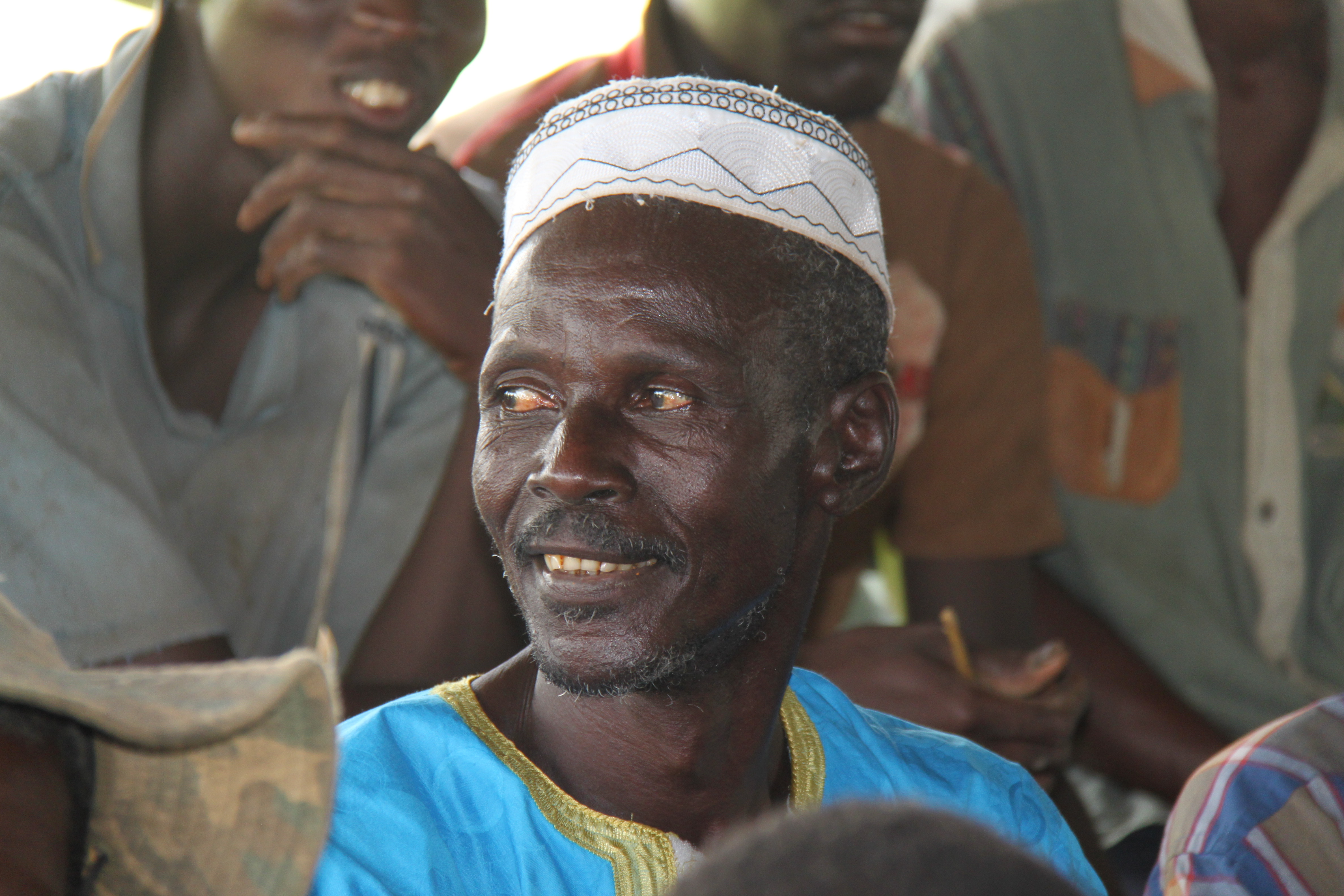
We arrive in a small community somewhere out of Kaffrine. I am listening as various producers talk about their business challenges. A man stands, pale blue Caftan with a Muslim that looks like a mosque all on its own, he is middle aged, face dark, proud and sun beaten like an like an extra in a fifties Saladin movie. He says his business is harvesting salt, he bought some land and in the beginning things went well and he was getting a good income. But now things have changed and his business is encountering many problems. And for the last two years he has barely make enough to feed his family. I ask him what the main problem is.

He says : “ My difficulty is the yellow two headed dragon that lives my land”.

“How big is this dragon?”

“ it is very big and yellow and has two heads and very powerful and ziss is my problem”

I didn’t do the dragon module during my MBA and so quickly get a brief from my trusty field staff.

“ So are these dragons real?”

“They could be”

“No I mean are there real dragons?”

“It is posseeble”

“But Benedict (Benedict is a very devout Christian) it doesn’t mention dragons in the Bible, neither on the ark or as any other kind of being. “

“Well you can’t say zey exist or zey don’t exist but it is posseeble, yas?”

“Benedict do believe in Dragons?”

There is the distinct inaudible but very clear sound of shuffling

“Yas it is posseeble….everything is posseeble in Seneegaal ”

“No Benedict do you believe personally?”

“Yas it is posseeble”

“So what do these dragons do?”

“Zey cause de very bad luck, very very bad luck”

“So what can you do to get rid of them?”

“I am not sure, but we can pway, we can always pway” and Benedict lights up, as though delighted with such a simple and profound answer, as though it was his own unique discovery in that moment .

Every man has dragons and every man must slay his own, and I know I am still struggling with mine and this salt harvester is looking at me like I have an answer brought across the seas. But I have to lie, I tell him that I am sorry we don’t have dragons where I come from so I can’t advise him. Only the second part of this is true.

Oh, and the funny thing is that six months after all of this, Belinda returned to Benedict. Everything is fine, they are happy and Benedict tells me that he was always sure that God would work it out.

(November 2011)


Posted in Postcards | Tagged , , , | Leave a comment

Fearless Hopelessness

Causal Loop V4

 “Whenever there is a simple error that most laymen fall for, there is always a slightly more sophisticated version of the same problem that experts fall for” Amos Nathan Tversky

Many NGOs working in international development are finding that their revenues are falling, there is increased competition for funds and people who are poor are at risk like never before because of food and water shortages, climate change, natural disasters, rising energy and input costs, refugee influx, population growth or migration. This can lead to new organisational pushes that focus on making staff redundant, redoubling fundraising and marketing efforts and a new emphasis on risk management to protect the organisations Brand. As management and boards seek to try to have more control of their destinies , organisations that pride themselves in bottom up development and field effectiveness can themselves become increasingly hierarchal, struggle with issues of transparency and focus on growth and internal efficiencies with lessening apparent concern for the quality of outcomes for people who are poor.

International NGO’s generally have audacious visions such as “for every child, life in all its fullness”…….“A world in which every child attains the right to survival, protection, development and participation”……..”A just world without poverty, in which people can influence decisions which affect their lives, enjoy their rights, and assume their responsibilities as full citizens of a world in which all human beings are valued and treated equally”. Each vision statement has at its core, hope within the hopelessness of a vision that can never become true. Some management along with marketers and fundraisers may well try to hold a world view that all development problems are solvable and the right strategy, focus, steady growth and clever marketing the organisation will sustain itself indefinitely.

I want to raise questions about what International Development NGOs really trying to sustain and why the promotion of hope and vision among each organisations staff is the most logical, effective and necessary approach to achieving each organisations Mission and Vision and sustainable future. And how an undue focus on size, the generation of funds and management of risks is in fact less likely to sustain the organisation in the long term than having fewer funds, more flexibility and focusing on which activities approaches and resources are most likely to achieve unsurpassed development outcomes.

In the hybrid causal loop/perspectives map (Fig1), I have attempted to depict linkages for how more funds, an aversion to risk, staffing whose fit is more important than abilities and systems that place predictability over need, are likely to undermine everything that might sustain an NGO into the future. A reading of the diagram suggests that the key element to NGO organisational sustainability is going to depend on how effectively impact and aspirations are achieved in the field, as well as how this impact is communicated to donors.

Some of the key conclusions that can be drawn from this Causal Loop Diagram are:

There is potentially a non-virtuous spiral that means more funds and more programming exposes the organisation to greater risk, posting threats to the Brand, causing more focus on risk minimisation actions, which leads to poorer development outcomes, which makes funds generation more diffulut, or at least risky, which leads in turn to more risk minimisation and a redoubling of efforts to raise more money.

The impact of an organisation wide “taboo” on discussing the true quality of the development work relative to the aspirations of donors and developing communities.

How organisational and staffing structures negatively impact on community development aspirations and how these lead to decreased development effectiveness and thus increased risk to the Brand of the NGO to its donor communities.

So what is it a typical International Relief and Development NGO trying to sustain?

A Vision Statement is a way of articulating the dreams and hopes for the people who comprise and support the organisation. The reason donors give their money to NGOs is in the hope that a difference will be made. Most donors will never meet the beneficiaries of their generosity but they give in the ‘hope’ that through their sacrifice, the lives of some people who are poor will be changed for the better, in sustainable ways, that their donation of itself, has made a real difference.

Aid agencies have consistently found that donors are more inclined to give money to support relief efforts to a few people who are impoverished rather than tens of thousands. Apparently the larger numbers are overwhelming and donors lose the hope that their contribution can actually make a difference. Thus the donor perspective is most likely to be one where they are supporting the NGO to provide a solution to a poverty situation.

From the perspective of an NGO, in this time of rising prices of food, fossil fuels and agricultural inputs, population pressures, environmental degradation, climate change, wars, famine, migrations, natural disasters and water issues, the larger perspective cannot be one of solutions but rather of a predicament or “wicked problem ”, where outcomes are better or worse rather than solved. In this context an NGO can logically only maintain hope and a vision for the future for some beneficiaries that is better rather than worse. In this context “a solution” is a hopeless aspiration.

It would seem that while a donor may have some hope in specific solutions the collective hope needed by the NGO’s leadership would seem by necessity to be a different kind of hope, along the lines described by Czech playwright, essayist, poet, dissident and politician Vaclav Havel.

“Hope is definitely not the same thing as optimism. It is not the conviction that something will turn out well, but the certainty that something makes sense, regardless of how it turns out. In short, I think that the deepest and most important form of hope, the only one that can keep us above water and urge us to good works, and the only true source of the breathtaking dimension of the human spirit and its efforts, is something we get, as it were, from “elsewhere.” It is also this hope, above all, which gives us the strength to live and continually to try new things, even in conditions that seem hopeless as ours do, here and now.”

Here Havel seems to be talking about how hope can still reside in hopelessness, as being something beyond the hope of results and instead the hope to do the right thing even if the challenge seems to be overwhelming.

Thomas Merton, the late Christian mystic and writer also talks of hope, and the hope he seems to be referring to is not the hope from finding solutions rather than the hope that survives in doing what is right, regardless of the consequences.

“Do not depend on the hope of results. . . .you may have to face the fact that your work will be apparently worthless and even achieve no result at all, if not perhaps results opposite to what you expect. As you get used to this idea, you start more and more to concentrate not on the results, but on the value, the rightness, the truth of the work itself . . . ..you gradually struggle less and less for an idea and more and more for specific people . . . .In the end, it is the reality of personal relationship that saves everything

What both Merton and Havel seem to be pointing to is that strength, inspiration and action can all arise freely in spite of a seemingly hopeless situation and that as Merton says within the “truth of the work itself”.

The “opposite” of hope is therefore not hopelessness but fear, as it is fear; fear of failure, fear of loss, fear of utter powerless that leads to despair; it is fear that saps the strength from hopes wings.

Thus the question arises: What would it take for an organisation, as an entity, to hold a vision within hopelessness, to be working within an overwhelming predicament, free from fear and be supported by tens of thousands of donors most of whom believe the organisation is providing solutions?

It would seem logical that International Relief and Development NGOs will not be able to survive indefinitely if there is a disparity between their vision and what donors believe they are supporting. Could it be that fear arising from the size of the predicament also has a role in over energetic fundraising, growth for growths sake, bureaucracy and risk management as substitute actions for work arising from “the belief in the work itself” that Merton speaks of?

An organisation, of itself, cannot hold hope within hopelessness, organisations have systems, structures, policies, resources and so on. It is the people within the organisation who will or won’t carry the hope and vision of such an utterly outrageous proposition of “a just world without poverty” or “every child who is today in poverty will experience life in all its abundance”.

It is paradoxical that NGO’s may ask donors to believe in an audacious vision and ask people in communities to increase their lots though self determination and belief in their own power to make a difference, and yet in their actions as organisations appear to be driven by fear thus sacrificing their authenticity with donors and communities alike.

So to rephrase the sustainability question, what is it that the organisation needs to sustain in order to do its work and achieve the most it can with purpose, effectiveness and relevance into the future?

I believe there is a strong case to suggest what will sustain Relief and Development NGOs into the future is the vision and hope of the people who make up the organisation and that the expression of this hope will lead to actions that improve the lives of people who are poor and offer opportunities for impact that are greater than the other alternatives available to donors. My hypothesis is that the leadership of these NGOs will need to convey each organisations vision in such a way as to realign the staffs worldviews with Donors and Communities who have more hope for change than is generally true within the NGO and its partners.

To survive and maximise its potential for impacting on the lives of people who are poor, my belief is NGOs need to refocus their leadership towards seeking to sustain vision and hope in the midst of overwhelming challenges.

For Development NGOs to sustain vision and hope in the midst of overwhelming challenges there will need to be the emergence of new and innovative approaches and new ways of reframing the “solution” orientation to one of “predicament”.

The only Wicked Problem strategy intervention consistent with international (community) development theory is “Collaboration” (Roberts, 2000), to work with all stakeholders to find the best possible options for proceeding with development approaches that builds the hope and vision amongst donors, NGO staff and communities. And to be less engaged with providing solutions than we are with improving predicaments. With this orientation hope does exist that we can communicate in new ways with our donor community and that our authentic aspirations will drive change throughout the value chains that we are a part of, towards more meaningful engagement with our stakeholders and better quality outcomes that are based on comprehensive shared visions rather than parochial short term survival activities.

 

Posted in Stories From the Road | Tagged , , | Leave a comment

Too dumb to keep but too hard to leave behind

Velingara

Meeting in the village of Foudou – The floor is earth and the sides are open, the essence of humility

Postcard from Senegal

It is March, I am in Dakar and have just been picked up from my hotel to go to the office. The Novotel is a better hotel than i am used to, modern French minimalist. I was upgraded to a room with a sea view but the room is dark, the sea view window is less than half a door in size, I suppose for some eco design reason, and at an angle so you can only see the sea if you stand right at it. I can make most things work and when I can’t it is apparently because i am not thinking enough like a Citroen mechanic. Some room features seem to work better when I try them backwards for example in the bathroom, up means on and down off and green means hot and blue means water flow and things of that nature. Some aspects remain a mystery, like the moulded plywood feature that covers the orange vinyl cushion on the stool under the desk. I arrived last night from Nairobi, the time is three hours behind, so bed was two a.m. and I am feeling it a bit this morning.

My drivers name is Aziz, his English is good and we make ‘morning in the traffic’ small talk.

“So how is the office?”

“The office is very fine”

“How is my friend Brett? “ Brett is originally from Canada and has been working in Senegal for a number of years.

“Brett is very fine.”

“Brett just got married?”

“Yes maybe one month ago and his wife is very beautiful”

“Have you met his wife? “

“Yes she is very tall, she is like the Cooka Cola”

“The Coca Cola?”

“Yeeees, she is tall and has good shape and is very brown………. like the Cooka Cola………and she has very good teeth. Aziz said this laughing so that the words and the laughing were all one.

We wind through backstreets of an old part of town, its all an old part, we pass the Hotel Croix du Sud a fine old art Deco style hotel built around 1950 that apparently used to be the best in town. It reminds me the Bakelite radio that my father gave me as a child to listen to the Argonauts on the ABC. We cross Boulevard du General de Galle, and go around Independence Square, which is the size of several soccer fields and in it are low concrete retaining wall instalments painted and sun bleached, un-kept paths and several dry fountains. It has a mad broken garden gnome feel about it. There have recently been some pre-election protest riots around here. We take a road the goes near the old market in an area that translates to something like “Walk of Barrels” and hit the coast.

Now we follow the road from the edge of the city centre along the coast towards the airport, we swerve only to avoid those things that might do us damage. Like donkey carts, or aging yellow Peugeot taxis. Pedestrians run between speeding cars like a dare. The street sign says Route de la Comiche Quest – ‘Road to the Comic Quest’, and I remember Don Quixote and wonder if we all need to be a bit mad to make sense of what is going on around us, not only here but anywhere.

Last time I was in Dakar, Brett took me to dinner along this same road, a clutter of buildings behind a taxi stand in front of little Luna Park that is all painted up like a harlequin hat. The Cafe Sportif is perched on a small cliff overlooking the beach. We arrived at dusk and watched the water turn from aqua to mercury to ink. And we talked about work and Africa and he talked of his upcoming marriage and me of lost loves.

When it came time to came to go, there was a scramble of taxi drivers around us and under coloured light bulbs draped in a tree and somehow we ended up in one of the old beaten up black and yellow Peugeots with a Rastafarian driver , he was high on something, maybe herbs or drink or just on life. A crafts hawker stops me closing my back door desperate to sell me three carved ebony monkeys each about the size of a Russian doll, hear no evil, speak no evil , see no evil. And I didn’t want them but I buy them anyway and pay a quarter the price he started at and still feel I pay too much. We lurch off up the road , the old 505’s diff is wining, the tappets sound like shaking rocks in a tin and the springs and shocks are gone and with every bump we bottom out with a jarring thud and each time I close my eyes, it has an end of the world feeling about it. The driver is shouting at us in French, we make the first corner and both his and my doors fly wide open like it was something they were supposed to do on cue. I nearly fall out but grab the door and slam it back in but the same thing happens at the next right hand corner and I move to the middle of the back seat, holding the back of Brett’s’ passenger seat with one hand and the opening back door with the other. And the driver is grinning and shouting and laughing and I can’t understand a thing he is saying but I am getting him anyway. And when I get back to the hotel room in the light, I see that two of the little monkeys are see no evil, accompanied by one hear no evil. They are too good to throw away, and too dumb to keep, but I pack them anyway. So many things in life seem like this and I am thinking of all the things I hold on to that are no good for me or for others.

My task this trip is work with two new business councils in their rural villages. We have some new Business Facilitators and part of their job will be to form as many as twelve business councils and so I am here to do some training and mentoring while actually in the field working with community groups.

We are in the office I am sitting with my colleague Benedict who is originally from Mali. We are planning the logistics for the week ahead. When I have visited previously the projects are generally three or four hours from Dakar, so if we leave early we can schedule community work in the afternoon.

“So where are we going” I ask.

“Velingara”

“Okay good, and how long will it take us to get there?”

“It is not so far” he says, but his eyes flicker

“Benedict” I say, “how far exactly is it?”

“It is a really beauuuutiful drive” Benedict says looking through me to the wall behind. “It is near the border with Ginea Bissau”

“Okay, how long will this beautiful drive take?” I ask

“Ten hours, but this is a very, very nice drive, a very beauuuutiful drive”

“Ten hours!”

“My broder “he says “everything is possible in Senegal”

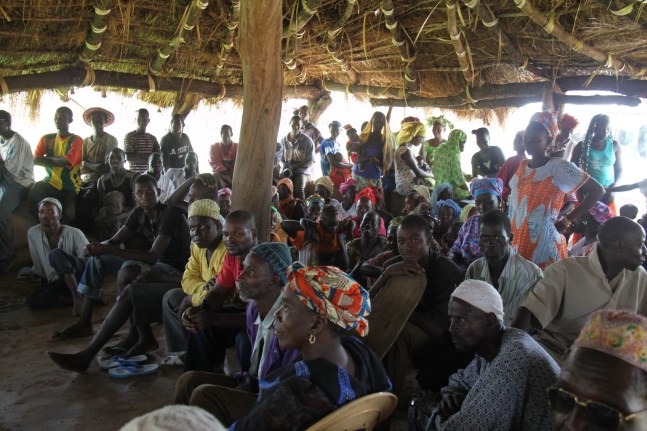
And so now it is two days later and we are in a community meeting place in the middle of a small rural village about an hour out of Velingara. We are seated in a shelter that can hold about two hundred people, the roof is a thick grass thatch bound to rafters with rope like raffia held on tree trunks each with a natural fork at the top to hold the rafters. The floor is earth and the sides are open, the essence of humility. People filter in and several men whom I assume are village elders bring traditional chairs, that have the dimensions of a deck chair and made from two wide rough hewn planks that both have a notch taken out about one third of the way along, to half the width, and so fitted together they form an off centric cross with the short side forming the seat and the longer the longer the back rest.

After about half an hour we start the meeting and I gather that about ten years ago we bought a large plot of land along the bank of the passing river for some struggling farmers and helped them develop it into a communal banana plantation. We provided big diesel pumps to irrigate from the river, the banana plants, the fertiliser and training. And when fences were needed to keep livestock and wild donkeys out we provided the materials. And for a while apparently this was a model project. And then as one thing or another went wrong or broke we fixed it. Everyone’s intentions were good and the community became increasingly dependent on us and we on them for results that might justify our increasing investment. It was a pity that no one had sufficiently researched the demand for bananas and now the famers are struggling to find buyers willing to pay a fair price.

Looking out over the fields, women and boys are leading donkeys pulling hand ploughs worked by men in kaftans of sky blue, cloud white, and earth brown . And I am thinking this project is like an old Volvo station wagon I once had, first I needed to replace the gear box and I thought after this all would be well for the future but soon it was the electrics that blew, so I fixed them and was sure that the car would now be worry free. But then the dif went and I replaced that and so by the time the power steering stopped working, I was so committed I didn’t really make a decision and when the radiator blew beyond repair I had invested so much that I couldn’t walk away because I couldn’t even sell it for the price of the power steering repair. That question again, what do we hold dear and what do we leave behind?

So as usual, I have no idea what discussion is going to be helpful for us, for them for all of us. So I asked the gathered group what they wanted to achieve and they told me they wanted World Vision to give them more school classrooms and more teachers and to find a buyer who would pay more for their bananas.

I have found that following my instincts is generally better than ignoring them and also that stories are often a first step to something else. So the best thing I could think to do was to tell a story about the opportunities. I said that it sounded to me that they were like some farmers caught in a flood who had climbed onto their thatched roof even as the water was lapping at the edges of the grass thatch. And there was a murmur and several people looked anxiously at the thatch overhead. And I said that the farmers were good Muslims and they prayed to God to save them and they waited in hope. Then after some time some fishermen came by in a canoe and offered to take them to higher ground but it looked risky and they said no, they were waiting for God to save them. A little while later a large tree that had been dislodged from the bank , brushed by the roof and as the waters were rising the famers thought of clinging to the tree and it taking them to safety, but they remembered that they had faith in God and after all, wasn’t it Gods job to save them? Before long the flood swept the roof off the house and it sank and the farmers drowned. There was murmuring in the group and I could sense at this point they could all see themselves swept away in the a swirling muddy river. And I said, the farmers went to heaven and there was Allah, and they said “Blessed Allah, why did you not save us?” And Allah said to the farmers, “Sons and daughters, what do you mean? First I sent you some fishermen in a boat and then I sent you are huge tree to carry you to safety”. And one of the village elders stood up and through translation said that he understood the message and that he saw they needed to use what they had been given and to take some risks to save themselves. So I asked him to chat with the gathered group. I know from experience that nothing is easy, that words are just words particularly from visitor and also that worlds can have power. I have learned that I generally can’t tell the difference. That all of us there that day hold a part of the truth and that all I could do was to try to contribute something that in some way may be helpful.

We are so often afraid to lose what we have even when logically there is a real prospect of gaining something of much greater benefit. Believe it or not academics have spent lifetimes researching risk aversion and decision making theory. Loss aversion refers to people’s strong preference to avoiding losses over acquiring potential gains. Some studies suggest that fear of losses is twice as powerful, psychologically, as the potential for gains.

I have noticed this when impoverished farmers have a strong reluctance to try new methods or even in some cases work together in new ways. They may recognize the theoretical logic of making a change but they are worried that deviating from their traditions poses a risk of losing the little they have. I have talked with farmers who would rather endure three or four hungry months than risk letting go of tradition trying something new that is likely to mean they will be better off. And it is not hard to see how in an evolutionary way this can make sense, at least they know with the old ways they will survive just like their parents and their parents before them. But there are always exceptions and risk aversion is not true apparently for gold rushes or martyrs.

It is not hard to see how the banana farmers quickly became dependent on World Vision and that when a problem arose they turned to us to fix them. A downward spiral where the more we invested the more we had to lose, the greater the community’s dependence, the less the project was successful the more we invested. And the question arises, “who is trying to sustain what for whom?” We believe in assisting communities increase their social capital and determine their own future and yet our fear of loss and failure can bind us into a spiral in which sustainable development is unlikely. And here that we repeated it for so long must have meant that we weren’t prepared to risk losing the little we had for in the hope that the community would and could find ways to do things themselves. And if we are not prepared to risk loss how can we expect the communities we work with to do the same? It is so seldom about the money and so often about our skills and abilities to take risks with others. And who is it that benefits from taking these stories back to our experts and our supporters.

I like the following quote from the late Amos Nathan Tversky who was one of the pioneers of decision making theory, he said:

“Whenever there is a simple error that most laymen fall for, there is always a slightly more sophisticated version of the same problem that experts fall for ”

Post Script

This was around a year ago and last month I saw part of a report and in it the following excerpt of a speech by one of the Elders from that village near Velingara:

“The village of Foudou exists by the will of World Vision; this is why we must not disappoint. World Vision has set up a banana with a major investment to develop the area economically. Therefore, I would like to return abroad about “Noble Jock” who came when starting the project with BDS Cisse (a new Business Advisor). If I remember correctly, he made us understand that we first had to rely on ourselves before seeking support from others. To return to the signing of this Memorandum of Understanding today between the partner and we Abdou Faye banana producers, I would simply say that we have an incredible opportunity to have World Vision as a “big ship” and Abdou Faye partner as “small ship” and if we are not careful we may lose these two ships if we do not redouble their efforts to succeed. If we fail, we are alone in the ocean and we risk drowning. Through these examples, I was merely a repeat explanations from abroad from World Vision Australia, to say we believe in and enjoy the opportunity we have today to move forward. ”

I am not really sure what it means, but I hope it means something true, and if that is the case then that will be a mystery to marvel at and if I am there next year and I have twenty hours to drive to and from Velingara I may just try to find out how things are going.


Posted in Postcards | Tagged , , , | Leave a comment

The Creator of Yerevan

The Creator of Yerevan

When I arrived in Yerevan I began to construct a new city; it is very similar to the Yerevan on my city tourist map and it is similar to the Yerevan of the people who have lived here all their lives. But this is the Yerevan of my creation. I have populated it with plane trees and nineteenth century buildings of grey basalt and pink limestone; with cobble stones and hidden courtyards spied through arched laneways; and people in the street in their apparent boredom or beauty, each carrying with them their hopes and fears. And me, making my way, new to this city, thinking about the opportunities I might have here to build a life and where I might live and how I might use this as a base to change the way we do development in this part of the world. I have also included the elderly white haired woman, long nosed and leather skinned in the seat on the bus beside me. I have made her a grandmother who has seen much happiness and much suffering under the Soviet time. And she has made her own Yerevan that is in many ways similar to the one I have created. But it is different; the streets in her Yerevan are longer and have more hazards; and the familiarity of the parks where she was courted as a young woman; and above the shop where over a dinner party in the home of her future parents in law her late husband proposed to her amid much laughter and happiness, for everyone had been waiting for that day.  And of the house where her daughter lives now with her grandchildren, and the house where her mother died; these landmarks will never be in my Yerevan. And this is a world she has constructed during her lifetime. And the young man on the seat opposite us, coming from university.  He has made a world that has very similar street layout to the old woman’s. But the streets are shorter and his landmarks are cafes where he and his friends meet; a lot of the detail of his Yerevan has yet to be completed as he only has thoughts now for the bus stop and the short walk up Mashtots Avenue, to the Retro Café and girl named Liana who he hopes will be there with his friends.

I see Mount Ararat, snow covered stark against the blue sky and the Mother Armenia statue, giant hard faced women, sword in hand, watching over the city. But the elderly woman sees a Mt Ararat that is a reminder of the land where her grandparents died during the genocide and of stories of the trek her parents made from Van. Instead of Mother Armenia she sees the statue of Stalin who looked over the city from that same place before it was torn down in the early sixties. And I go on creating this Yerevan and take it into my soul, step by step, brick by brick as I wander through the streets of this city built nearly three thousand years ago. This Yerevan, that last year, it did not exist to me.

(Inspired by Vasily Grossman – An Armenian Sketchbook)

 Reflection

One way or another we are all creators of the universe we inhabit and somehow we are inclined to forget that each of us inhabits a different world of our own mental creation.

And on top of this, just as we have evolved physically so we have  evolved to make use of different ways of processing the information around us. Our wasy of seeing any world evolved within us and now forms a lense we look through to make sense of our environment and live in it. And the reality is that we are not all looking through the same lense.  If our response to our environment we have evolved an orange lense then the world seems orange to us and we make sense of it as an orange world, if in response to our environment we have evolved to  a green lense the same whole world seems green.

In international development this reality can be overlooked and dangerous. At one level we know that people inhabit different worlds but at the same time we can still think that once they see our world, as we see it, they will leave their own and join ours and our way of seeing it.  And the folly of this is identified in the story above. As author I am not burdened by the ties of the past and see opportunity to change this part of the world, my naïve optimism is not constrained. The elderly woman is woven into the cloth of the place; she is an integral part of the community here and its history in ways that I can never be. Perhaps she struggles to come to terms with a State that is no longer as controlled and tough as times often were then;  there is no longer certainty, as there was under the Soviets, where work, housing and food were guaranteed. And to the young man, who at this time in his life is very focused on himself, sees many future opportunities; what he will do and how he will make things work for him belong to a code that he is making up as he goes along.

To make the inquiry easier I will name each of the world views in the story above with a color and attribute the color with certain characteristics, and for this I will use Ken Wilbers stages of consciousness as a guide[i]. We will suppose the elderly woman’s worldviews Amber and the University student’s as Orange and the writers way of seeing and making sense of the world is a mix of Orange and Green.,

The elderly woman has an Amber way of seeing the world; Because of the way she makes sense of the world she tries hard to lead a stable and purposeful life. She sees life as having meaning, direction and purpose with predetermined outcomes. She avoids conflict, believes in conformity and fitting in and that it is important to sacrifice herself for a larger cause, to do her duty, to honor what is rightfully determined by others higher up and the laws of the state and the rules in her religion.

It is important to her that she does what is expected and she believes that diligence leads to future rewards and in the necessity for the laws, policy, regulations, rules and discipline to maintain order where everyone will ultimately be better off. She believes strongly in principles of right and wrong, black and white; being faithful, maintaining order and harmony and she has a strong sense of personal guilt if she thinks she hasn’t done enough.

So it is worth noting here that she differs from the author in two fundamental ways; her world in this case Yerevan is quite different from his and the lense that she looks at this world with is also very different and can’t just be replaced through some logical arguement.

The University student has a world view that is primarily Orange. His Orange way of seeing the world means that he is driven by a desire for success and personal autonomy. He sees self-interest as most important; if he doesn’t look out for himself then who will. He is inclined to see that progress is right and inevitable, that there are winners and losers – he wants to be a winner and prosper. He knows he will need to take risks for this but is optimistic that relying on himself he will succeed. He is competitive, goal focused and believes that science will always triumph and the earth’s resources are there for him to make use of so that he can prosper.

Ultimately for him it is results that matter, he wants to be an initiator rather than a follower, he wants to use his time well, to be effective to build a future in which he is the principle beneficiary. He works on being logical, driven by data and experience and is very goal oriented.

And the writer who has a world view of Orange similar to the University Student but is also moving away from the individualistic world view of Orange towards the community wellbeing and consensus worldview of Green. A Green way of seeing the world is that people can work together as equals moving beyond self-interest to more idealistic views of shared understandings that promote trust, justice and human rights for all and live in harmony with nature. To do this the Green world view is quite prepared to ignore the old rules and seek to develop new ones for the good of all.

Within International Development there are multiple dimensions where these worldviews can collide within the organization, with stakeholders, government and communities. For this reflection however, I will only reference the development organization itself. We might have aspirations constructed idealism but then the primary implementers might generally have a “center of gravity” at Amber. This means that while the achievement of the aspirations may require flexibility, risk and comfort with uncertainty, ambiguity and continuous learning, the body of the organization may be centered in conformity, policy, rules, risk minimization, control and how everyone fits in to a similar world view. At the same time the Amber implementers may perceive that they don’t have the requisite flair, creativity and new thinking that Orange could provide, yet when they try to bring Orange into the system they are inclined to stifle the life out of it and Orange can’t survive. Green also finds it difficult to survive in the Amber system for while it understands Amber it can become exhausted as it continually fights for enough flexibility to survive. In this ‘Stages of Consciousness’ way of making sense of the world, a stage can only really understand the Stages below it and of the three worldviews described, Green is higher, followed by Orange, followed by Amber. Green can in principle understand both the worldviews of Orange and Amber and Orange can understand the world view of Amber. But Amber only sees those systems below it, not those above – in this case Orange and Green. So when the organization’s center of gravity is Amber then it tends to want all other worldviews to see it’s view as the highest view, which may be sustainable in a bus company where order, maintenance and scheduling are critical but it is a problem in something as messy and multifaceted as International Development.


[i] The part of the reflection of the color profiles draws heavily on an excellent paper by Barret Brown: Brown, Barrett (February 2007). An Overview of Developmental Stages of Consciousness, Integral Institute. Based upon research by: Ken Wilber in Integral theory and Integral psychology; Clare Graves, Don Beck, and Chris Cowan in the development of values; Jane Loevinger and Susanne Cook-Greuter in the development of self-identity.

Jock Noble is the Lead or World Visions Economic Development Learning Hub for the Middle East and Eastern Europe. After a career of trying to teach turtles to fly he finally got into the water and is learning to swim with them.

© Words and pictures Jock Noble: Original pictures by the wonderfully talented Armenian Artist – Anna Avetisyan


Posted in Stories From the Road | Tagged , , , | Leave a comment

In Praise of Dreams

Postcard from Solomon Islands

We are sitting in a circle on white plastic moulded chairs on the sand. I am in Honiara with a group of Solomon Islanders, they are speaking of high youth unemployment, few jobs and little money, of feelings of alienation about the past, about the current power structures which tend to shut young adults out of decision making, of no real sense of a better future and of cheap plentiful alcohol.

In Praise of Dreams

There is an elderly woman in the group, sitting in a pink chair, her lips and teeth are stained with beetle nut, she doesn’t speak English and she is wearing a tee-shirt that says, Social Hazard – Will Not Conform, and on her in this moment it looks right for her and it looks right for us.

We are here to talk about what to do. I don’t have the answer and they don’t either but that we are talking about it as thought the discussion and the answers matter, is a start. No different from anywhere in the world, who am I and what will I do? Who are we and what will we do?

Next day I decide to find out what some children in this community think. And at my request we go to a school where some colleagues know the teachers. Here are village children, whose families are not wealthy but they have enough to provide their kids with the basic uniforms and books. There are about 25 village boys and girls; I guess the average age is around ten years old. They stare at me wide eyed. I greet them and ask some questions and they respond in whispers like wind in grass and I can’t make sense of what they are saying. The staff is looking at me as if to say, “this is going well…….not”. So I collect all the adults and divide the kids into small group with an adult to shepherd and ask them two questions. What would they like to do when they leave school, what are likely challenges they think they will face? The answers that emerge are probably the answers that one would expect from kids in any school in the West. Three of these kids want to be doctors, two want to be airline pilots, two want to be lawyers, one an architect , two policemen, several want to be nurses, a couple teachers, one wants to be a carpenter and another a farmer. The challenges they express are whether their parents will have money, whether there will be peace in their homes, whether there will be less violence, less stealing, less drinking. In our culture we celebrate dreams, there is apparently an American dream somewhere in the DNA of 360 million Americans – God Bless America and the American people. And I am thinking that the chances of most of these little ones finishing form four is small, and the chances of them attending a university or college are infinitesimally small. And so what of these youthful dreams? Should these children be discouraged from having them? Will they be wounded by them? Does it make sense to even have such dreams?

American author Dave Pollard[1] writes, “When things are hopeless – Give up hope, embrace hopelessness, it makes sense.” A Tibetan yogi once said of dreams; “ like the birds that gather in the treetops at night, and scatter in all directions at the coming of the dawn”[2].

The late American author Joe Bageant said in one of his Blogs “Hope is for little kids and tooth fairies” and living in a Mexican village he spoke often about the satisfaction that people there had with their world and how in his view the western idea of hope and aspirations added nothing to their lives.

“…. in the morning the roosters crow, and wood smoke stirs in the air, and this village wakes up, and does all those ancient things decent people do in so much of the rest of the world. Old women sweep the street in front of their doorways, men uncomplainingly go in search of a day’s labour, and young mothers nurse babies in the courtyards, full knowing that what they see around them is all there will ever be for them, and that the Virgin of Guadeloupe blesses each morning. Just as their mothers and grandmothers knew it. Already they are tired for the world. But not joyless……… Hope is for little kids and tooth fairies. The world we awaken to each morning is the only real thing there is. And if we are spiritually, morally and philosophically intact, and humble enough to feel it and love it each day, we don’t need to hope some unseen force or bunch of politicos, or an “economy” or so-called leaders are gonna make it better for us. The orchids outside my doorway are blooming and my wife still loves me after all these years.”

Call me naive, but I thought saying “hope springs eternal in the human breast” was from the Bible, God telling us something about how we were made. But that is not right, it comes from the poem “An Essay on Man” written in 1734 by the poet Alexander Pope. I don’t know anything about Pope except that he is not God and I am thinking that he probably didn’t know much more about the qualities of hope in poor communities than I do, and that is not much.

[1] Author. 2007 author Finding the Sweet Spot: A Natural Entrepreneur’s Guide to Responsible, Sustainable, Joyful Work (2007) Blog: How to Save the World, [2] Shabkar Tsodruk Rangdrol Tibetan Yogi (1781-1851)

Posted in Postcards | Tagged , , , | Leave a comment

When You Have No Choice

Ndabibi

I am flying into Nairobi from Dubai, I have been in the air for twenty hours since leaving Melbourne, twenty eight hours since I locked the door of my apartment. The TV screen on the centre aisle bulkhead shows map of East Africa and the position of our jet between Kisumu and Nairobi, there are a smattering of other familiar names and places, Mount Kilimanjaro, Mombasa and further down Dar Es Salaam, Zanzibar. The text on the screen reads Nairobi 29 mins. I slept for a total of around four hours and so have joined “the thousand yard stare club”.

There was a five hour stopover in Dubai where I caught up on emails in the Emirates lounge and made Cappuccinos from a machine with more buttons than a flight deck. In the air, I watched four or five movies, they merge into each other, a collage of past lives and dreaming and now I am having flashbacks, like pop up boxes, lifetimes of well meaning people making dumb choices, betraying each other in unhappy romances with predictable endings, the man and woman who can’t stand each other, until their best friends die leaving them a baby to try to raise together, the Woody Allen Movie where half a dozen people’s lives become increasingly precarious as their various dreams implode. Please turn off all electronic devices, stow your tray tables, bring your seats to the upright position, and open the window shades. I look to window, blinding bright after so long the timeless lounge light of the cabin, I squint through the glare and the terrain below takes from, a crazy web of dirt roads etched white on the beige brown Kenyan landscape.

The plane makes one very steep bank and then another, shudders a little as it slows, banks again slicing the sky like the sweep of a blade and straightens for the last decent. The city of Nairobi, buildings in a haze are out to the left and an arid expanse, as far as the eye can see, to the right. I don’t understand the need for these steep banking manoeuvres but it is always the same. There are special people waiting for me in Kenya, people I love and I my heart swells a little when I think of some of my meetings over the next few weeks. I wonder if hearts only break through love.

A few days later in Nairobi I am with my friend Nimo and carrying six one litre bottles of spring water the kilometre back from the supermarket to the hotel. It is hot; the air is thick with the diesel fumes from noisy, badly maintained city busses. It is hard to talk above the noise of the traffic, trumpeting horns, and the cries from Matatu touts. The sidewalk is uneven and the plastic supermarket bag is cutting into my fingers.

Finally we reach the hotel, go to the open air cafe and order tea. Nimo is a beautiful Kikuyu woman working with an NGO in Nairobi, she has coffee coloured skin, platted braids in her hair, almond tiger bright eyes and a laugh like a bird’s song. It is so good to sit, to put the water down, to watch the busy street life rather than being part of it.

“That was heavy” I say, opening and closing my hand to get the circulation back.

IMG_1618

“I am glad…. “I pause, “You know the women I have talked about at Ndabibi?” Nimo nods. “They carry 20 litres three or four kilometres and often a child as well, every day, sometimes twice…….whether they feel like it, or not. I have just realised in a new way how hard that must be.”

Nimo says: “When you have no choice, you must be so strong”. She says it flat, the way you can say things if you know they are true today and still true tomorrow. Nimo is from a village and carried water as a child.

Nimo’s statement sits somewhere in me, stuck in the space between my brain and the back of my eyes. We sit without talking; the roar of the city surrounds us.

The streetscape is a thing alive, a mass of dark skinned humanity. A man in a white short sleeved shirt so unhurried as to be almost slow motion, another making long purposeful strides, one moving faster, quick and out of step with the throng, turning his body left and right, a matador in the crowd. A women in a bold African print, some hawkers selling magazines, sunglasses, maps and bright sun umbrellas, faces eager, resigned, hopeful , hopeless, I begin to ponder what separates them from me? But it is too noisy to think. A Mhindi[1] in a suit passes, he is wearing a gold watch and chain around his neck. He is nowhere near as invisible as he probably thinks, perhaps he is a visitor, and unlikely he will have the neck chain for long, even here downtown. A small gang of street urchins swarms around a middle aged couple, Mzungu[2] tourists, red faced and flustered, lost looking.

Later I am thinking about what Nimo said, “When you have no choice you have to be strong”. I have a feeling that my own multitude of choices often undermines my ability to be strong and to do wholeheartedly what is necessary and just and healthy and true. So often I have the luxury to do what I feel like doing, in my sophistication my conscience has become something to “take responsibility” for. As I think about this now, feeling like doing something is just one way of deciding what to do and how to act and actually I may make better decisions if I didn’t relate so closely to what I feel and instead I just do what needs to be done. Thoughts about lilies and birds and sowing and reaping and growing and toiling and spinning all somehow adding up to some kind of encouragement to be present, or in Swahili Hakuna matata; “there are no worries”.

Some of my work in Kenya’s Rift Valley is an area we call Wema , we work with communities in two areas, one is Weseges and the other Maji tamu and we have combined the two names. Weseges people are primarily Kalenjin and in Maji tamu the people are mostly Kikuyu. They are traditional rivals and at times there has been violence between them. We are meeting in a hut with a tin roof, concrete floor and split log walls. Bright light shines through spaces between the logs like halogen in the half light of the room. The windows have no glass but shutters for lock up. It is like the hut in a Wild West movie and has recently been taken over by the Waseges committee on loan from the local government and the group has renovated it. They have installed a 2 meter square blackboard at one end and the room is filled with white plastic moulded chairs. The group proudly tells me they purchased the chairs from membership contributions. I am meeting with around 25 men and women who comprise management committees from the two economic empowerment groups. Normally I ask them to tell me what has happened in each of their group’s during the six or so months since I last visited.


When you have no choice

Getting a true sense of what is happening can be awkward as the achievements for one group in some areas may overshadow the other and there is an unspoken competitiveness. This time I decided to try something different. I made a vertical chalk line on the blackboard and at one point put ‘Start’and the other end I put “Now”. And then I asked all those present to help me plot the achievements of the last 3 years. And from their own history it emerged that they saw the first year was about dreaming what might be possible, the second year was dealing with difficulties and disappointments including many resignations within the committees and some confusion about direction. And then when we came to the third year there were so many actions and achievements that there was hardly space enough to write everything in. And I joked that is seemed like a marriage; the first year was the honey moon, the second year we realised the reality of our choices and that our choice to work together was not going to be easy, commitment and faithfulness were required not just dreaming. And the third year was when the babies came and now it was our work to nourish and build what we had created. And there was a great explosion of laughter and and little speeches by various members about the truth of this.

And I said, “Do you remember when I had first come and you said “Mzungu, tell us what we should do” and you looked at me expectantly with you notebooks out and the pens ready? ”

Heads nodded and faces lit up, there were smiles and a hum of agreement

And I asked them,

“Does anyone think now this Mzungu can tell you anything about what you should do?” And we all laughed and laughed, like it was the silliest thing in the world.

This may seem a very small thing, but I treasure these small diamonds that shine unexpectedly from hard rough ground. Here and with these people I seem to know what to do.

Back in Nakuru I am staying at Merica Hotel, it is owned by a former politician and is the best hotel in town. I am sitting in the lobby waiting for a friend and there is an African wildlife documentary on the big screen TV. It is soon apparent that this is the story of the dry season and of a crocodile filled water hole that is slowly drying up. There is no commentary it is simply a visual account of the helplessness and horror of the animals that are forced to come and drink. I watch as a mother baboon has its baby snatched from her arms by a crocodile and she fights the croc and so lovingly retrieves the dying baby that it brings tears to my eyes, an antelope so perfect in its shape and coloring, black body stripe against its svelte beige body, ventures timidly for a drink and has its head bitten off by another croc. A young monkey loses its arm as it tries to get a mouth of water, it escapes confused skin hanging where its left arm used to be.

I am thinking that there is much that is not benign or romantic or beautiful about this planet, it is really a very violent and savage place. And that things are not like this because of something I have done, not my original sin, not even what my people have done or not done. But I can make choices which may make things better.

I talked with Nimo on the phone this morning. Nimo shares an apartment with her sister and brother in law, in Nairobi’s Eastlands, she says it is safe enough during the day but it is not safe to be out after 9pm. This morning when Nimo stepped onto the rough dirt road on her way to work, there was a mob and two young men lay there, ragged and bloody. One was dead, the other barely conscious, an outstretched arm clawing at the ground, as though to drag his body forward. It was only 7am Tuesday morning. They had snatched a local woman’s mobile phone and been chased by the mob and stoned. Nimo told me she had to pass within a few metres of the young man who was still just alive.

She said “The image of this boy is burned on my mind and I can’t get it out”.

Nimo soon found out from her sister that this young man also died.

Nimo said, “Okay was very wrong what they did but who could tell how they were loved as children and okay they were wrong but the young men who stoned them are poor and just like them as well”.

And I am thinking it is so unfair that she must now carry this image like a wound.

Jock Noble

Nakuru, Kenya January 2011


There are two fundamental questions posed by many sages. “Who am I? And how will I live?”[3] And I think who are we, what will we do? St Augustine[4] of Hippo’s definition of a community is “a multitude of rational beings united by agreeing to share the things they love”. I am worried about what my community loves. I am worried by what I love. I am wondering if too many times, I am giving myself too many choices about how to live and what to do. [1] An Indian, literally “the one who speaks Hindi” [2] Swahili for white men and women, derived from “the one who looks lost” [3] Who am I?” became a famous self enquiry and teaching given by the Hindu Saint Bhagavan Sri Ramana Maharshi at the beginning of the twentieth century [4] St Augustine of Hippo In ‘The City of God’ written early 5th Century

Posted in Postcards | Tagged , , , , | Leave a comment