The People of Rome

There was once a traveler who was on his way to Rome, it was a long and dusty path and he had misgivings about the city. He had heard so much, travelled so far and he was nervous about how he would make his way in the new city. A days walk from Rome he reached the top of a hill from which Rome in its glory could be seen. And sitting in the shade of a rock sat an old man. He walked over to the man.

“Wise one” he said, “ I have traveled far, please tell me, what are the people in Rome like?”

The old man looked at him for a moment and said, “Where are you from brother?”

“I am from a village outside Athens sir” replied the traveler.

“And how are the people there?”

And the traveler replied “The people from my village are generous, kind and understanding, they welcome travelers and treat all men as equal”

“Well” said the old man, “You are in luck, for the people of Rome are just the same”

Image

The following day another traveler reached the top of the mountain, looked toward Rome, noticed the old man and walked over to him and said: “Wise one, I have traveled far, please tell me, what are the people in Rome like?”

The old man looked at him for a moment and said, “Where are you from brother?”

“I am from a village outside Athens sir” replied the traveler.

“And how are the people there?”
And the traveler replied, “The people from my village are mean, unscrupulous and lack any compassion, they are suspicious of travelers and only look after their own interests.”

“Well” said the old man, “I regret to tell you that the people of Rome are just the same.”

Reflection

We often feel that a situation is bad and many times we relate this with particular events and circumstances that seem to us unique to that situation. However so many times we fail to ask ourselves if we have encountered the underlying issues before and whether it may in fact be us who is the common element. We are inclined to take our baggage with us.

I believe that wisdom is paying more attention to what is going on around us than the next person and seeing our part in this; and this includes us recognizing our part in repeating patterns. We are almost never a neutral party in anything we are a part of.

Thus for International Development we must try to see how we take our own projections into various situations, staff groups and communities. And be aware of our own inclinations to make judgments and prophesies based on our own assumptions and then to see how these tend to become self-fulfilling. Just as the travelers in the story above we tend to see our situation as being the result of others behaviors rather than the result of our own interactions with others. We expect others to be open to change and have positive mindsets when so often we fail to be genuinely open and positive ourselves. We expect others to have self-belief when we do not believe in our own power to be real catalysts for change. And we expect others to take risks and be advocate for change, when we do not take risks or challenge the authorities in our own circumstances.

Jock Noble March 2014

Jock Noble is the Lead or World Visions Economic Development Learning Hub for the Middle East and Eastern Europe. After a career of trying to teach turtles to fly he finally got into the water and is learning to swim with them.

© Words and pictures Jock Noble: Original pictures by the wonderfully talented Armenian Artist – Anna Avetisyan


Posted in Stories From the Road | Tagged , , | Leave a comment

The Oracle

Once upon a time there was a village where the people were hungry and dissatisfied with their situations and no one knew what to do. The chief of the village summoned the strongest young man and said, “Go over the mountains, find the wise Oracle and bring her to us; she will tell us what we need to do”. So the young man set off and after much hardship and many weeks he found the Oracle and brought her back to the village.

The Oracle asked, “So I am here, what is the problem?” And the villagers replied, “Great Oracle we are hungry and unhappy!” and the Oracle asked them, “So what is the answer to your problem?” and the villages stared at each other in confusion and one brave villager replied, “We are hungry and don’t know the answer to all the problems in our village, that is why we sent for you so that you can tell us the answers.” And the Oracle asked them many questions about those things that the villagers already knew about their situation and about the challenges they were facing and the reasons, and then she said, “ You know a lot about your situation, if you can’t find the answers in what you already know then I won’t be able to help you”. And slowly she stood up, picked up her walking staff and without another word began the trek back over the mountains to her home. The villagers looked at each other in disbelief; they had expected the Oracle to give them a simple answer that would solve their problems. Wasn’t she the one they had been waiting for, the one they had put their hopes on, the wise one? Some villagers were disappointed, some were discouraged and some were even angry.

Image

Some months went by and the poor conditions in the village had not improved, so the chief consulted with the elders and they agreed, they would send for the Oracle again to seek her wisdom. They agreed also that this time when she asked if they knew the answer to their problems, half the village would say they knew the answer and the other half would say they didn’t and in this way they would elicit the answer from the Oracle to what they should do to make their lives better and more successful.

So again the young man was sent to beg the Oracle to visit and she consented and together they slowly made the journey back to the village of hungry people. And again she asked if they knew the answer to their problems. And as they had agreed, half the village said that they knew the answer and half the village said they did not know and they asked the Oracle what they should do. The Oracle thought for a moment and then said, “Those who know the answer tell those who don’t know.” And then she took her walking staff and without another word left the village.

That night the chief had a dream and the next day he called everyone together. And he said, “The Oracle did in fact give us the answer but we didn’t have the ears to hear it. The answer is that the solution to our problem lies within us, because we can only respond to things we already know to be true. If they were beyond our comprehension we could not respond, so anything we can do is within our comprehension, so the answers to our problems are already with us.”

Reflection

I have told this story many times. On one occasion I was talking with a group of staff in Vietnam about local value chain development. They had been furiously taking detailed notes and I had the strong sense that they were expectantly waiting for me to give some miracle solution for what they should do for producers in their communities. They all had a copy of the ninety page local value chain manual and they wanted copies of all available PowerPoint presentations as well.

I could feel the pressure on me to be the expert but was very aware also that the answers were not in the notes. So I stopped and said something like:

“Market development is easy, first you find out what buyers are buying, then you find out what people are producing, after that, you and the community try to figure out how the market might work better so that producers can get more for their products. And this is generally by assisting producers to buy inputs like fertilizers and better seed, to supply more of what the market is demanding and increase their bargaining power by selling collectively. And to the extent that it is possible, farmers work together and partner with other organizations with which they share common interests. Then you all work together and innovate what seems to be working so that whatever successes have emerged can be maximized and experiences are shared about what has been effective. At various times you take a step back to see what the impact has been and what can be learned and discussed for the future.”

And everyone agreed that they knew this already and that it was helpful when it was spoken so simply. And so I told the story of the Oracle above and then said:

“The answers are already with you. And the answers are in the communities you work in and you must be the Oracle to them; just as I must be the Oracle to you, the one who helps you see what you already know. And perhaps helps you fill in some of the missing pieces when you have decided what you want to do.”

I believe there is something we all need to learn about our tendency to believe that answers lie outside ourselves or beyond our ability to find them and our tendency to believe in the power of the expert to solve problems that only we can solve.

I think as development professionals we too often fall into the trap of our own need to be useful, which quickly becomes us wanting to be the experts, to hold the answers, to want to be of more value in pitiful situations and not to disappoint the expectations of those we are working alongside.

Posted in Stories From the Road | Tagged , , , , , | Leave a comment

Stone Soup

Once upon a time there was a traveler who walked all day without food and arrived at dusty village; two rows of small stone and mud walled houses with broken tiled and tin roofs each side of a stony potholed dirt track. It was hot in the early afternoon and the village smelled of charcoal fires and cow dung. The villagers sat on split log benches pressed hard against the walls of the houses or squatted in the pools of shade under the few trees in the central common near the village well. The flies were thick and tried to find moisture in the corners of the kid’s eyes and mouths and around the goats that looked for the last blades of grass and weed. Into this village the hungry visitor made his way.

The first person the traveler met was a women walking with two small  children and when he approached they clutched her skirt and moved behind her peering at him around the folds of tattered fabric. The traveler said, “Mother, I am hungry, can you spare a few mouthfuls of food?” But the woman said, “We too are hungry uncle and no one here has any food to spare, I can’t even properly feed my own children.”  The traveler knocked at the door of one hut and then another but the villagers who came to the door said the same. The visitor was travel-weary, tired and hungry he took rest for a while under one of the trees.

In the cooler part of afternoon he went to where the well was and spoke in a voice loud enough to be heard through the whole village. “I see everyone is hungry, and so I am going make a big meal and feed everyone, please come and join in the feast, this evening we will all eat well today.”

The visitor asked for the biggest pot in the village and someone brought it, he asked for some fire wood and the kids collected what they could. And the man asked the children to fill the huge pot with water and he then put it on the fire. And when the water was boiling he took out a large polished stone from his bag and announced. “I will now make stone soup!”

After some time the visitor took out a spoon from his bag and took a mouthful of the steaming liquid. “Ah it is coming along well, I think it just needs a little salt, can anyone spare a little salt?” and someone brought some. And the pot bubbled and the villagers chatted amongst themselves and waited expectantly. And the visitor again tasted the liquid. “Oh wonderful” he said, “Its coming along well, all we need are one or two onions, can anyone help with two onions?” And the onions  were supplied. And so the soup bubbled and every so often the visitor would taste the broth ask for one more ingredient, one time carrots, the next potatoes, and the next some chili and the next some corn and finally a chicken.

And when the soup was ready everyone had more than they could eat and there was plenty left over.

Image

(The story of Stone Soup has no known author, is apparently some hundreds of years old and is retold in many countries in many forms, from nail soup in Scandinavia, to Axe soup in Russia)

Reflection

After telling this story I ask participants, what they think this story is about. And someone generally says , “It shows how when everyone works together there can be more than any one person working alone.” And typically everyone nods. And I ask what else? And sometimes someone will say something like “The traveler had to trust and believe that the villagers had it within them to respond, otherwise all they would have had was hot water with a rock in it and the visitor would have to run for his life. “

And that to me is the is the wonder of this story, that a visitor to a community would be prepared to risk himself or herself not based on a belief that their job was to be an expert or to own a success but to take a risk that other could be shown they have the answer. To have faith in the possibility that ignited belief in one person might be the beginning of fire and change a world. And this is unlikely to ever happen through a log frame for soup or a professional Power Point presentation, or some action learning or evidence building activity.

The shadow in the story is the voice of the skeptic, what in fact is the traveler really offering?  We all have our own answers to this but certainly he is offering his belief in people and he is trusting in peoples curiosity to take a leap of faith towards something, in this case a never before heard of soup. There is a magic in this and he is the catalyst of it. And the magic is performed through the courageous belief of the traveler. Of course he is hungry for a result and keen to meet his own objective to eat a meal. He is not a neutral player. And neither are we as development professionals. We all need each other and the leap of faith taken by the communities we work in, to succeed.

The traveler holds a vision, he cannot be sure how the soup will progress or what the community will be able, or prepared, to offer. And yet in the story, as in life, something can manifest from very little.

It is also significant that the traveler is the only one who is potentially putting his life on the line, he has more to lose than the villagers. They are only offering what they can actually spare. The traveler like the development professional is offering himself, his credibility, his future in that village, perhaps even his life; he is raising hopes with no certainty of the outcome.

Yet by his faith alone, in himself and in the community as not being different in essence from his own character, humility and brokenness, he is able to build and generate the trust that brings about something none of the participants could have done on their own.

In the international development context, my view is that this story is more about the courage and unshakable belief needed by development professionals than it is about communities being able or obliged to work together.

Jock Noble March 2014.

Jock Noble is the Lead or World Visions Economic Development Learning Hub for the Middle East and Eastern Europe. After a career of trying to teach turtles to fly he finally got into the water and is learning to swim with them.

© Words and pictures Jock Noble: Original pictures by the wonderfully talented Armenian Artist – Anna Avetisyan


Posted in Stories From the Road | Tagged , , , , , | Leave a comment

The Foolish Man

Stories From the Road

The Foolish Man

There was a poor man who lived at the edge of the town in a house of old bricks, with poor fitting windows and a rusty steel roof. In summer his house was very hot and in winter it was cold, when it rained the roof leaked. The man felt he never seemed to have any luck, he had stopped taking pride in his appearance and his hair was unkempt and his clothes ragged. He had just enough land to grow enough food to feed himself. The man had tried to find work but one way or another the jobs finished and he felt he was never further ahead, it seemed the more he worked the less he had to show for it. His wife had died after their first year of marriage and he was childless. And though he would have liked to marry again he thought he had nothing to offer prospective brides.

One day he resolved to go and find God and tell him of the unfairness of his life and ask God to grant him a favor. So he set off into the forest in search of God.

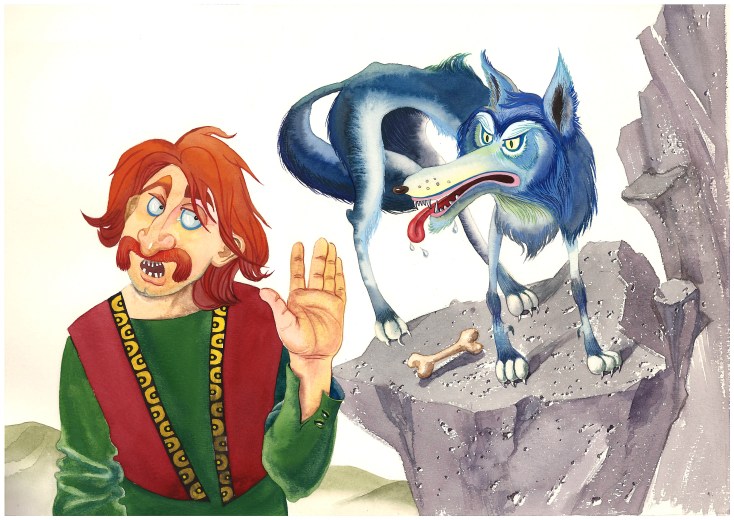
On his way he met an old grey wolf, so thin its ribs showed clearly. The wolf growled and asked the man where he was going.

“I am going in search of God” said the man “ To tell him of my trials and sufferings. “
The Foolish Man2

 “Well” said the wolf, “ Since you are going to find God, when you see him will you please tell him there is a wolf roaming in the forest who cannot find food and is hungry day and night. As God created me please ask God to feed me.”

The man committed to tell God about the wolf and continued on his journey.

Not long after the man met a pretty young woman collecting small wild flowers in the forest.

“Where are you going” she asked the man.

“I am going in search of God to ask him to help me.”

“Then” said the young woman, “Please tell God there is a pretty young woman, healthy and rich who is not happy. Please ask God to help her.”

The man committed to tell God about her and continued on his way.

After some time the man came to a tree on a dry bank beneath which was a flowing stream. The man sat in the shade of the tree to rest as he had been travelling all morning.

The tree spoke to the man saying “Traveler where are you going?”

“I am going in search of God” said the man “I am going to ask him for help”

“Well” said the tree “ if you are going to ask God for help, please ask him to help me also, please tell God there is a dried up tree on a bank whose roots cannot reach the stream below and it is dry on the bank all year round.  Please ask God to send some water so that I may become green again.

The man promised to tell God of the tree’s plight and continued on his way.

Eventually the man found God manifesting in the form of an elderly man with a long white beard sitting in the shade of a high rocky outcrop.

“Lord” Said the man, “I have come in search of you.”

“You are welcome”, said God, “What can I do for you?”

The man said, “Life is not fair and I want you to be fair to everyone, I work twice as hard as many I know yet they are rich and live well and I am poor, lonely, often hungry and unhappy.”

The Foolish Man

God though for a moment and then said, “Please go now and you will be rich, I grant you luck, go find it and enjoy it”

“I have something else to tell you Lord” said the man, and he told God of the troubles of the hungry wolf, the pretty young woman and the dried up tree.

God promised he had help for them all and told the man what he must do. The man thanked God and began his journey back, almost at a run to begin his new life as a rich man.

On his way back he came to the tree.

“What is Gods message to me?” said the tree

“God told me that you have a pot of gold buried beneath your roots and once it is dug out then your roots will become free and you will be green again.”

“Wonderful” said the tree, “then you are just the man to dig out the gold, you can keep it for yourself and then I will be green again.”

“No” said the man “I have no time now, I am in a hurry, God has given me my luck and I must now go and find it so that I can have a happy life.”

And the man rushed off and almost ran into the pretty young woman who had been waiting for him.

“Sir what is God’s word for me? How will I ever be happy?”

“God told me that you must find a precious friend for yourself and then you won’t be sad anymore and your life will be joyful and you will be happy,” said the man

The young woman gazed openly and directly to deeply into the man’s eyes and had he looked he would have seen her tender heart, “Please! Will you be my precious friend?” asked the young woman with much feeling.

But the man averted his eyes “No, I have no time to be your friend” said the man, “ God has given me my luck and I must go and find it and enjoy it”. As he said these words the man was already leaving at a half-run rushing off up the path.

The man had not gone far when the hungry wolf ran toward him on the path.

“Traveller, does God have a message for me?” said the wolf

The man told the wolf that God had told him that the wolf would go hungry until he found a foolish man. And when he found one he should eat him immediately and he would be satisfied.

Then the wolf said “Where on earth am l likely to fine a man as foolish as you?” and with that he ate the man and was satisfied.

(This is a retelling of the story “The Foolish Man” by the famous Armenian poet and writer Hovhannes Tumanyan 1869 -1923)

Reflection

I have used this story in a variety of forms in communities who are poor as well as with staff working in those communities, to create a discussion about what as a community we have now and what we think is missing.

Firstly of course, is that we have the eyes to see, that there are people and opportunities around us that we can work with to improve our condition.

If we are waiting on Government, NGO’s., Head Office or others to change our luck, the likelihood is that we will be missing those opportunities that can be grasped in the present. This is obviously the basis of  a “Strengths Based” approach or sometimes we call it ‘Appreciative Inquiry’.

I often talk about what I see as the three elements of action for change. There is “I” and what I can do, there is “we” or “us” and what we can do together and there are “others” such as key persons, institutions and/or NGOs who we can approach and discuss mutual interests. The “I”, “we” and “other” dimensions align with the dimensions of our worldviews: egocentric, socio-centric, and world-centric. These dimensions relate as much to the way the staff of NGOs see the communities they are working in as they do within communities themselves. In the story of “The Foolish Man”, the poor man misses the opportunities around him not only for wealth, but for love and happiness. It is easy for us to miss the point that it is likely through our interactions with others and benefiting them as well that we ourselves can find what we are looking for or what is promised to us. It is also the case that if we don’t have a flexible mindset that our own tight focus will also keep us from the opportunity to unlock the power and love in others, just as the story’s foolish man demonstrates.

I have found that more likely than not, the best outcomes appear in unexpected quarters and our role, as facilitators of change, is to be mindful enough to notice them and by recognizing them to make them real in a new way. We may have a focus on value chains or small business development however we are wise not to overlook the pride of a man saying, “Before I began working for my community based organization I was just a poor man, now I am helping change lives, my life is meaningful and I am respected.” Or the group that sends two representatives to local Government meetings to voice their community’s need for roads and water who say, “Before we were part of our committee we would never have dared to come to these meetings and speak for our community”. And this mindfulness is also what the man in the story lacked. In his very focused quest for results he ignored the wider picture and missed everything that he had hoped to gain. This not only kept him in the “individual – I” state, but it meant that others also could not fulfill their opportunities through his agency. And predictably he died as a result, as often does the hope in individuals and community groups or in our own staff. These issues of focus, unfulfilled possibility and death relate just as much to well-meaning programs as they relate to individuals. A program design can have a narrow view of success and staff can sometimes be so focused on achieving the aim of the program that they not only miss opportunities for transformation but do damage to others as did the foolish man. Inflexibility or inert program designs or logframes can also encourage a narrow focus or mean that we do not have a broad enough perspective on what we measure as beneficial change.

I have found the I, We and They (or the Other) perspectives very useful in focusing staff groups and communities on what can be done. It also helps focus on the short medium and longer term nature of opportunities.

I always start off with “what can individuals do?” and then move to the group. Only then do we discuss how individuals and or the group can engage with “others”. Invariably if the group begins talking about its collective neediness, what they think needs to be done, most actions tend to end up as the responsibility of the “other”.

Another extension of how worldviews can fundamentally change a situation, are the perspectives of first, second and third person. The foolish man is stuck in the first person world view and his interactions with the other players in the story don’t move him to include them. A second person perspective would open up his view to consider me and you, the man and the maiden, or the man and the tree, for example and what they can do together for mutual benefit.  A third person perspective would be the “view from the balcony” where the man can potentially see himself as part of a design and his place in a broader system and see how he can potentially work differently as part of a bigger picture of potency and opportunity.

There is always a wolf ready to pounce on the foolish. The man had the opportunity to avoid the wolf with riches and a new wife and bring new life to a tree and its sustainability for generations. Who knows he may even have been able to feed the wolf.

God in this story has effectively told the man, that if he doesn’t change his perspective the wolf will eat him, the man actually gives the wolf this message himself. Thus it is really only a change in worldviews that would allow the man, or individuals in a community to “keep the wolf from the door.” Not to change is not a viable option as it makes us, as communities or development professionals vulnerable to the hazards that are always present.

Often the place of God and divine intervention comes up and my response is to acknowledge God as the fundamental giver and to say that what he has indisputably given us at this time is ourselves, each other and organizations and institutions we can share our interests and messages with.

Jock Noble November 2013,

Jock Noble is the Lead or World Visions Economic Development Learning Hub for the Middle East and Eastern Europe. After a career of trying to teach turtles to fly he finally got into the water and is learning to swim with them.
Posted in Stories From the Road | Tagged , , , , | Leave a comment

You want buy gun now?


IMG_3702

Postcard from Lebanon

The proprietor of my local Milk Bar in St.Kilda is a Lebanese man in his fifties named Frank. Frank is short, thickset, mostly unshaven, often in shorts and thongs and always looks unhappy. Frank grimaces rather than smiles. He calls regulars “mite” but he says it like a threat. Frank is generally bitching about something, how the local prostitutes steal from him and the attitudes of the Irish backpackers or the rise of street crime.

One night a few months ago, late from work, I dropped in to pick up some milk and in the shop is a young woman, attractive, dishevelled, early twenties, confused. Her hands are trembling and her body tense, her hair is messed and maybe she slept rough last night. She is wearing a short lime green cardigan which looks odd over her pale floral cotton dress. The girl is asking Frank the where she can stay. Frank doesn’t do help so I ask if I can assist. The girl’s mental health doesn’t look so good and at the moment I am guessing that she is spiralling, looking for something to hold on to and afraid. In the wild in Kenya I once saw a male gazelle walking toward a lion, he knew the lion was watching and he wanted to see if the lion was hunting or if he could graze in peace. So he kept walking closer and closer, it was the weirdest thing. This kid knows she is getting closer to her craziness and she doesn’t know whether to be afraid or not, so she is tense, scared and walking in to it all the same.

I ask the girl what she wants to do and she says she wants to find backpackers hostel to stay in. So I buy her a carton of chocolate milk and I take her big red hard plastic suit case and put it on the back seat of my Volkswagen and we drive to a backpacker place up on Chapel St. The girl goes in and comes out and says it is full, and we go to another place on Fitzroy St. The girl goes in and comes back and says it is full as well. And after several more hostels I ask her what she wants to do. It is getting late and we have been driving around for an hour. I talk her into going back to her Grandmothers place which is where she says she has been staying. I know the street near Ripponlea Station and we drive there and I drop her off. As I see it, all of us are on a continuum of mental health, not good or bad, just better or worse and the girl has the right to make her own decisions.

We stop at a californian bungalow on Oak St and she goes up the path to the front door and I drive off but park 200 meters up and watch my rear view mirror. In a few minutes the girl comes back out through the gate to the street, dragging that big old heavy plastic suitcase, her determined little body leans forward against the weight. I wonder if it really was her grandmothers and anyway she just wanted to do something different. In the dark she has more courage than me. I wonder if there is something more I can do. She needs help but I don’t feel it is right to take her home to my house and I know she is not sick enough for a CAT team. I drive off feeling confused and unsure.

Next day I drop in to the Milk Bar and tell Frank that I tried to help the girl but ran out of options and took her back to her Grandmothers. Frank says “Mite why didn’t you just take her home and !V<% her”. Frank says it sharp, he means it, he seems to resent me for not trying to take advantage of her. Like I said, Frank doesn’t do help.

“Love gives naught but itself and takes naught but from itself. Love possesses not nor would it be processed; for love is sufficient unto love.” Today I am in Lebanon, the home of Frank from the Milk Bar and also the land of the great poet, mystic and artist Kahlil Gibran. Lebanon stretches 150 km end to end and is about 50 km wide. The Mediterranean laps up against its western coast, its southern border is with Israel and the rest of the county is surrounded by Syria. Damascus is less than 100km from Beirut.

I am here for work. We are involved in youth initiatives for young people in the Palestine refugee camps. Some camps have been there since 1948. The camp we visit is really a small city, a patchwork chaos of concrete houses pressed in against narrow lane ways and streets. The tangled spaghetti mess of electrical wires go from house to house room to room all external and at head height so you have to duck and you know some must be live. In this one camp last year during the rains thirteen people died, electrocuted from live water streaming of the wires into the lane ways. The travel advisories all say the camps are unsafe for visitors because of kidnappings and extremists. But there is no feeling of danger as families go about their business and young men stare with curiosity not hostility at the western visitor. I am afraid that my grandchildren will say to me, “what did you do when the Palestinians were being persecuted, did you learn nothing from what happened to the Jews in Hitler’s Germany?”

On my day off I have arranged to have a look around. The taxi driver I hired is named Fouad, which he proudly tells me means “heart”. Later on I forget his name and just call him Mr Heart. The late model Nissan saloon smells like an ash tray. Right now we are on our way to Byblos, which is one of the oldest continuously occupied cities in the world, going back over seven thousand years when it was used by fisherman and sheep and goat herders. It is my first time in Beirut and as we drive along the main north south road through the city, I still can’t get over how almost every building has shell and small arms fire pockmarks on at least one wall. Often there is distinct shell peppering around a window and I imagine that there was a sniper there once whose life was changed forever during one of the civil wars or invasions of the last thirty years. I read some of a local newsprint guide book in print since the 70’s and come to know that Lebanon, one of the smallest counties on earth with a population of just over four million, has been ruled by just about everyone; this is including but not limited to the Canaanites, the Hittites, the Egyptians , Alexander the Great, the Romans, the Byzantine Empire, Muslim Arabs, the Crusaders, who lost it to the famous Saladin, who lost it to Cyprus who lost it back to the Muslim hordes, who lost it to the Turkish Ottoman Empire, then back to the Egyptians, back to the Turks, then the French, then back to the Turks, , then the Allies in WW1, then the French again, then back to the Allies in WW2. And since independence there has been more or less been constant conflict between the Shiites and the Sunnis and the Muslims and the Christians and some organisation called Druze, a faith in which three quarters of their two hundred and fifty thousand loyal followers, are not allowed to know what they believe in. I am wondering what this means for a sense of identity. The history and the politics here are just too complex for me to get a handle on. And I am thinking that actually the history and politics everywhere are too complex for me to get a handle on and I am wondering whether it is important to even try. I see no evidence around me to suggest that Santayana’s statement, “those who don’t learn from history are doomed to repeat it”, is true, in fact it is those who focus on their history that most seem to have trouble moving forward. I am thinking it is just as likely that the future is forged by those who survive and keep on moving, like Lots wife, looking back can be a problem. I mean birds presumably don’t lose any sleep grieving ‘once we were dinosaurs’.

I say to Fouad,

“Lebanon is wonderful, the mountains are breathtaking, the men are handsome the woman are beautiful, the food is rich and delicious and people are so friendly. Your country has been beaten up by every other country in the region for seven thousand years why isn’t Lebanon neutral like Switzerland.“

Fouad’s dark eyes fixed me in the rear view mirror and he said louder than he needs to,” Because every Lebanese people is stupid…….every 15 years they make it war”.

We pass a supermarket sized Berretta gun shop with dummies wearing camouflage suits in the lit windows and holding high power rifles with long magazines and there is big stuffed deer with antlers.

I point to the shop and say, “Is there any game to shoot”

Fouad’s face lights up and he becomes animated and says, “You want buy gun now?”

“No, I am just interested is there anything to shoot in Lebanon except people?”

“Now just bard. “ he says somewhat sadly

“What?”

Fouad flaps his elbows impatiently as he drives “bard….bard”

“Are still any deer”

“All gone”,

“What about pigs?”

“All gone, just bards now”.

And I am thinking hitting a bird with that high powered rifle in the window would be like hitting a hitting a man with an anti tank rocket, wouldn’t be much left, but ……. we pass more buildings with bucket sized rocket scars.

So many apartments, office blocks and hotels sit gutted, rooms and parts of rooms exposed or missing, frequently on one corner the upper floor is folded against the level below, other buildings seem abandoned and then alongside themthing some brand new. Most buildings are two and three storeys with the top floor unfinished waiting for the next generation to add another storey to the expectant concrete pillars and rusty reinforcing steel sprouting out of the top floors like bad hair.

In Afghanistan during the late seventies, before the Russians went in, I was in the hills near Musarsharif watching the Pashtun game of buzkashi. Horsemen drag a headless goat around a field and you can’t predict where the reckless bravery of the riders will take the game. You are squatting on a dusty rock strewn slope in the sun and your heart is racing, your muscles are tense and you know that this game has no exact field of play and every rider is out for themselves and you are there at your own risk and you are not playing, but you are in it all the same. Lebanon is like that.

In the centre of the Lebanese national flag is the picture of the famous Lebanese Cedar . Fouad tells me the two existing remaining old growth cedar forests are not worth visiting “don’t go, the forests are finish and very bad but new tree coming”. I get the sense that Fouad thinks that the last seven thousand years has been a rehearsal for Lebanon’s eventual greatness, like an aging spinster with no suitor preparing for a wedding, all expectant and almost believable.

We reach Biblos and park at the old souk of cobbled stone lanes and curved stone archways. I wander from there down the hill past some roman looking pillars in a field, past a little cave grotto with people praying outside, to the old harbour. It is a natural inlet the size of a soccer field filled with twenty or so small fishing boats, The port is partly surrounded by Greek and Roman ruins including a small tower one side of the mouth. I take a table at Pepi’s Biblos Fishing Club which overlooks the harbour.

This restaurant was made famous by the glitterati who visited during the 1960s, before the civil war. On the wall are pictures of Pepi in a sea captains hat surrounded by presidents, politicians and film stars. Anita Ekberg, Kim Novak and Ginger Rogers in black and white behind big texta autographs on photo paper rippled with age an moisture. I stand beneath the flotsam ceiling of the glass floats, nets and cray fishing baskets that have been painted and made in to lamp shades, I stand where the dead Stars stood look at the view of the small harbour. I wait for my seafood lunch alone except for a German tourist who is messing with his big Canon camera.

I walk back up the hill and when Fouad sees me he guiltily puts out another fag and though I have paid him for the day he bustles around the car, opening the passenger door for me like he can’t wait to leave. “You want go now?” he says expectantly. But I just leave my heavy camera and go to the market and by a piece of flat shale with a fossilised fish the size of sardine embedded in it. The fossil comes a certificate which attests to its authenticity as an extinct species over one hundred million years old.

When I return to Melbourne I give the rock with fish to my mother who passes it around to the other ladies at ‘mix and munch’ at the outer suburbs retirement village where she lives. And everyone is amazed by the stark perfect skeletal relief of the tiny hairlike bones and no one can picture what one hundred million means. And so I tell my Mum that if every year was one millimetre then a meter would represent one thousand years and so that makes Jesus two meters away and the ruins at Biblos seven meters and the life of that fish a one hundred kilometres. And I have no idea what this really means and Mum looks at me troubled, like she doesn’t recognise me. And I am thinking how mad it is for that sea fish in shale, chiselled out of a mountain 800 metres above sea level in Lebanon with a history that can be described as 100 kilometres long can turn up in a suburban living room in Melbourne. I am contemplating that maybe it is better to drag our big old red suitcase out into the night into a new future than trying to make too much sense of where we came from.

Posted in Postcards | Tagged , | Leave a comment