Watering Hope

I am back at Ndabibi for the first time in around 3 months and attending the regular monthly meeting of the NDAMAMO Economic Empowerment Group. I have now known most of these thirteen members for about two years. I have seen several leave and others join, but they have been very stable and focused. One member recently resigned when elected as the local member of parliament , I learned just a few minutes ago that Bernard who is the president lost his wife last month. I am proud they have stayed together during the post election clashes even when there was killing in the ADP and many residents had to flee for their lives because of their birth tribe. The ADP had to close for over 3 months because of serious safety concerns for the staff and several staff have been permanently relocated because of their tribe.

They call me the father of their committee, not because I have provided any money, in fact far from it, I have only ever been a mentor and watered the hope that they already have. And so far, this small crumb, has been enough for real changes to take place.

Bernard is the president of the committee, he is a small farmer and trader and from what I can gather he does well buying and selling butchered cattle shins. Figure that. And now,  Bernard is giving me a verbal report on the committees activities. He is frequently interrupted by other committee members when he overlooks some fact that someone thinks is important.

Bernard is telling me about the first Annual General Meeting of the committee. Apparently there was supposed to be someone there from World Vision Kenya to help them with the meeting but they didn’t come, so that committee was there on its own along with 130 of their 151 members. There are a lot more people who want to join Ndamamo as members, but the committee has frozen membership for now, as it scared of growing too quickly or not being able to meet community expectations for economic development initiatives. Members pay 50 shillings, around Aus $0.80 per month to belong and for many that is around a day’s pay so it is a significant commitment and provides accountability expectations on the committee much stronger than any NGO performance contract.

So, Bernard Continues “ Jock it was vary vary scary” and someone else echoes this, “Yes, vary vary scary” and says Bernard “They asked us very challenging questions” and the echo repeats “yes vary vary challenging” .

And gradually the story from last week’s AGM was told. The membership had come accusing the committee of receiving money from World Vision, and they were asking why should the committee be asking them for support when they could access funds from the very wealth World Vision office.

The committee rightly denied that they had received any money, they were able to explain that they had not benefited personally from an overnight exposure trip to visit another economic development committee, that World Vision had arranged for them, and that the World Vision Tent that the meeting was being held in, was just borrowed.

Well, it turned out that the Committee was successful in gaining the trust and support of their members, the constitution was ratified, it was agreed that free and fair elections would be held according to the constitution and the treasurer committed to keeping books of account in such a way that every income and expenditure was noted and could be viewed by any of the members.

As a result the committee now has a stable income of its own and has rented its own temporary office for 3000 of the 7500 shillings they receive from members each month, And, they have received an undertaking from the local authorities for a one hectare a grant of land, and the power company KenGen looks like giving them a further grant to build a small business center.

But the one thing the committee are now all very sure of,receiving any assistance from World Vision is a two edged sword and any thing that is given needs to be meticulously recorded and that without proper accounting and community participation, they will loose the support of their community along with the chance of a sustainable and independent future.

Jock Noble Kenya June 2008

Posted in Postcards | Tagged , , | Leave a comment

Is there peace over there?

There are twenty five of us in the earth floored corrugated iron church. We arranged the rough timber pews into a kind of semi-circle. Leah one of the economic empowerment group members from Mbogoini leads the group in a couple of welcoming songs, we sing loud, we clap loud in unison and I am trying to imitate the graceful swaying of the men. We have gathered for two days to continue to work on a community lead economic development strategy. The members have made great progress since I was last here 6 weeks ago. This is my fourth visit over the last 12 months, we are like old friends now and I can almost remember everyone’s names.

Wema ADP* is about four hours from Nairobi by car, first to Nakuru then a hour and a half to two hours on a track that is often more like a dry rocky river bed than a road. Real bush Africa,; passing small settlements of round walled mud huts with grass thatched rooves. Lots of life on the road, big horned African cattle, herds of goats and children goat herders, people walking with loads, with walking sticks, kids going to school in tattered uniforms, bicycles laden with bags of corn or firewood,, the occasional Matatu (local passenger mini bus).

Wema ADP is really in two parts, split down the centre by a rough rocky ridge, joined by one almost impassable track. There is no regular public motorised transport between the two halves of the ADP and there has been little contact between the two groups. They are from different tribal groups and there was trouble between them during the violent post election clashes earlier in the year.

Before the clashes I was facilitating each group separately but since then, I decided to do joint facilitation with the two groups meeting together.

That is why this is now such a big group. But together they decided on which priorities to tackle; Microfinance, access to markets, and what we are loosely calling infrastructure, in the form of roads water and forestry. The groups now have three very active subcommittees of six people each , three from each side and they have been meeting regularly. At one point we talked about the challenges faced by the committee. The two biggest, were getting to a meeting because some members have to walk for over two hours………….each way. The second was hunger, if they miss their late morning millet porridge then they may go hungry for the day and that they said made it hard to concentrate during their meetings.

I was very humbled when I learned the group members rejected an offer from World Vision to provide lunch and instead, today had contributed their own money to provide a lunch of Ugali (thick corn flour porridge) bitter green vegetables and meat ,as a demonstration of the self determination that we have been focusing on in our strategy discussions and workshops.

So the singing is over, the pastor of the church has decided to sit in on our workshop for today and he leads us in a prayer, and I being my asking for reports on what is new and whether being part of this group changed anything for them.

I heard that one of the committee members who had joined since I was there last had died. Jack reported that he had gone to visit the government officials responsible for providing water and wells in the area and had learned of the government’s plans and what the area was entitled to. Jack said it was only being the leader of the water committee that had given him the courage to go and ask questions and voice the community’s needs.

Then Peter, who has no front teeth, told how being part of the subcommittee to work with reforestation had made a difference to him.

He said that people from his side of the ADP ask him, “is there peace over there? Are you safe? “ And Peter said he answers, “there is peace, and I am safe and I am working with my brothers on the other side, so that we all have more water and more trees.”

And he went on to say “ when our group was travelling together on our way here this morning, we passed a school where there were no trees for shade, and we all said, we must plant trees around that school and we didn’t think this is their land or it is not. We said this is OUR land that school needs trees. And we will do it.”

* Area Development Project

Jock Noble, Kenya April 2008


Posted in Postcards | Tagged , , , | Leave a comment

Dear Mr Sirolli……

Dear Mr Sirolli……………..

One of the primary influences in developing our Business Facilitation pilots in Africa has been the development work done by Dr. Ernesto Sirolli over the last 25 years. In 1999 Sirolli published a book called Ripples on the Zambezi[1]. In it he tell s the story of how as a young Italian aid worker, he was part of a project which attempted to assist a poor Zambian Village improve their livelihoods by introducing a luscious variety of Italian tomatoes to boost the incomes of local people. The Italians made a selection of choice but unused land along the river flats of the Zambezi River and employed the locals to clear and cultivate it. They proceeded to plant their tomato seeds and the crop as it developed exceeded their expectations. Tomatoes bigger and better than anything the villagers had ever seen, results better than the Italians had hoped for in their wildest dreams. The fruits grew and a bumper harvest was anticipated. Then one morning one of the Italians came back with very disturbing news. The whole field had been completely destroyed , as if ploughed, and the whole crop was gone. When villiagers were asked why had this destruction had occurred they carefully explained to the Italians that the Hippos had come up out of the river and demolished the crop ………..and that is why they never try to plant anything on the river flats.

This was a seminal experience for the young Sirolli who concluded that the best kind of development consisted of assisting people do what they wanted to do, mentoring their imagination and energy and not trying to impose anything, never taking responsibility for the individual but facilitating them on their own journeys.

And so you can imagine how excited I was to learn about how the Business Facilitation committee at Ndabibi in Kenya, where we have had had a key mentoring role over the last two years, had sparked a women’s self help group to go into growing water melons.

The project at Ndabibi, is nearly hours from Nairobi in Kenya’s Rift Valley. Ndabibi is a strikingly poor area where for most of the year it seems that farmers are farming dust. When it rains much of the top soil washes off the hills and forms a mud that makes it impossible to grow corn on what used to be the most fertile planes. And there is no water storage to capture the run off. The farmers who live there are from a eleven tribes , shifted there as internally displaced persons after various tribal conflicts during the last 20 years. The area was particularly badly hit in the post election violence earlier this year, and when I visited in May many residents were only just returning to their homes.

And so this makes the story of the Chemi Chemi Women’s Water Tank group all the more amazing. This group of 200, very poor women, stayed together throughout the recent violence and in March when it was essentially over, banded together to jointly buy an acre of land of their own. Not only had they bought land but they had decided to plant watermelons as a new cash crop, and more than just deciding this, had actually planted the melons.

So when I visited in May and in acknowledgment of my mentoring role , it was with much pride that they took me to their land, showed me the baby watermelon plants and my colleague Olivia and I plant trees there.

The whole project was accomplished before I or the project staff even knew that it was happening, we had nothing to do with the acquisition of the land, the organisation of the group, the buying of the seeds or the planting of the crop, which is for everyone involved, the cause of much pride.

I was back there again late August and it was with much anticipation that I looked forward to seeing how the crop had fared.

The story was not a good one. The rains were late, the land was parched and brown and that meant that all the wild animals were hungry. It turns out that the Hippos had walked 4km from lake Naivasha and completely destroyed their crop.

And so the moral of this story which will no doubt be of interest to Mr Sirolli is: don’t count your melons until the hippos have been catched.

But the story will not end there, the group is not giving up, remains full of hope and is exploring crops which are less attractive to Hippos and Zebras.

Jock Noble

Kenya June 2009


[1] Sirolli, Ernesto, 1999. Ripples from the Zambezi, Passion, entrepreneurship and the rebirth of local economies

Posted in Postcards | Tagged , , , , | Leave a comment

St. Theresa’s

Last Sunday I went to St.Theresa’s of the Perpetual Jakarta, no I made up the part about ‘Perpetual Jakarta’ but I really did attend the morning mass at St. Theresa Catholic Church with my Chinese – Javanese friend, Clarita.
August 15th as I am sure you know, is the day when Roman Catholics celebrate the Assumption of the Blessed Virgin.
At St.Theresas, we celebrated this last Sunday. The “Assumption of Mary”,……….I say it a few times to try to get the feel of it, then it strikes me that as a native English speaker and knowing all the words in this particular ‘label for a day’, I have no idea what it means. Clarita tells me it is the day that celebrates Mary’s ‘assumption’ into heaven. And I am musing, so Jesus ascended and Mary assumed? I ask her is it really “assumption day” or is it really “absorption” day, and I am starting to mumble about the different perspective that this gives the term ‘self-absorption’ and heaven, and whether heaven is within and my friend gives me a ‘don’t make fun of my religion’ look which could easily progress into a difficult lunch time conversation ; so I return to trying to make sense of the prayer sheet, and then to trying to look serene in the 34 degree heat. I flap my program about trying to get some air. I consider trying to engineer the program into an efficient fan. We are sitting right in the middle of the church, surrounded by about 1000 people. No evident means of escape. The air-conditioners aren’t working. So I look at the cross and start to pray that Jesus will in fact save me. But though life like, from where I am sitting Jesus doesn’t look like he is going to be that helpful on either the heat or escape fronts. To the right of the crucifix is a full size very life like statue of Jesus and to the left a very life like Virgin Mary. I start to think about Jesus’ brother James and assume Mary wasn’t still a virgin and what this means. Like we are all virgins at a certain point in time, and then we aren’t, and how strange it is the Mary gets the Virgin tag as a prefix…..forever. Like, I am thinking to myself, as a Protestant, before I did anything wrong, I was a saint and then I did, and I wasn’t and now I’m not. Anyway above all of this is a dome and across the base of the dome high above the officiating priests and the crucifix are head and shoulder stained glass pictures of men. I count thirteen. The centre one is Jesus. So that leaves 12. Hang on, I thought there were 13 apostles, then I think no Paul was an apostle and not a disciple maybe there are 12 disciples, maybe there were 13 but Judas got dropped on account of following unpopular instructions. I begin to think that I know less than I thought I did about who these characters are, and why they are there, and what about Judas.
No joy for me around the alter, and I switch my attention to the people around me, people from so many nations, Chinese in beautiful silk prints, Filipinos in those shirts I always associate with Ferdinand Marcos, and Filipino ladies with very big hair. Indonesians in lovely batiks, a lot of Africans. I am guessing the ones in the caftans are from Africa representing something, and the ones in tee shirts with bodies from some men’s fitness magazine are probably US Embassy Marines. The occasional wet blotchy white face. There is a young Indonesian man in from of me in jeans and a black tee-shirt. It says across the back in big white letters, “Highway to Hell” and I am thinking , yes………. this probably is. Why didn’t I notice that before. It is certainly hot enough. And on the tee-shirt underneath the ‘Hell’ banner is a face , ah so there is Judas, but no, its Bon Scott, complete with horns and leer, I really am actually starting to hallucinate. An hour or so passes and I think I am taking with the deceased Bon Scott and then my legs are going and Clarita and I are stepping out the side door and past what Clarita says is “Mary in the Ghetto”, ‘Grotto Clarita, not Ghetto’. Though she is probably there as well, particularly on this her feast day.

Jakarta July 2008

Posted in Postcards | Leave a comment

The People of Rome

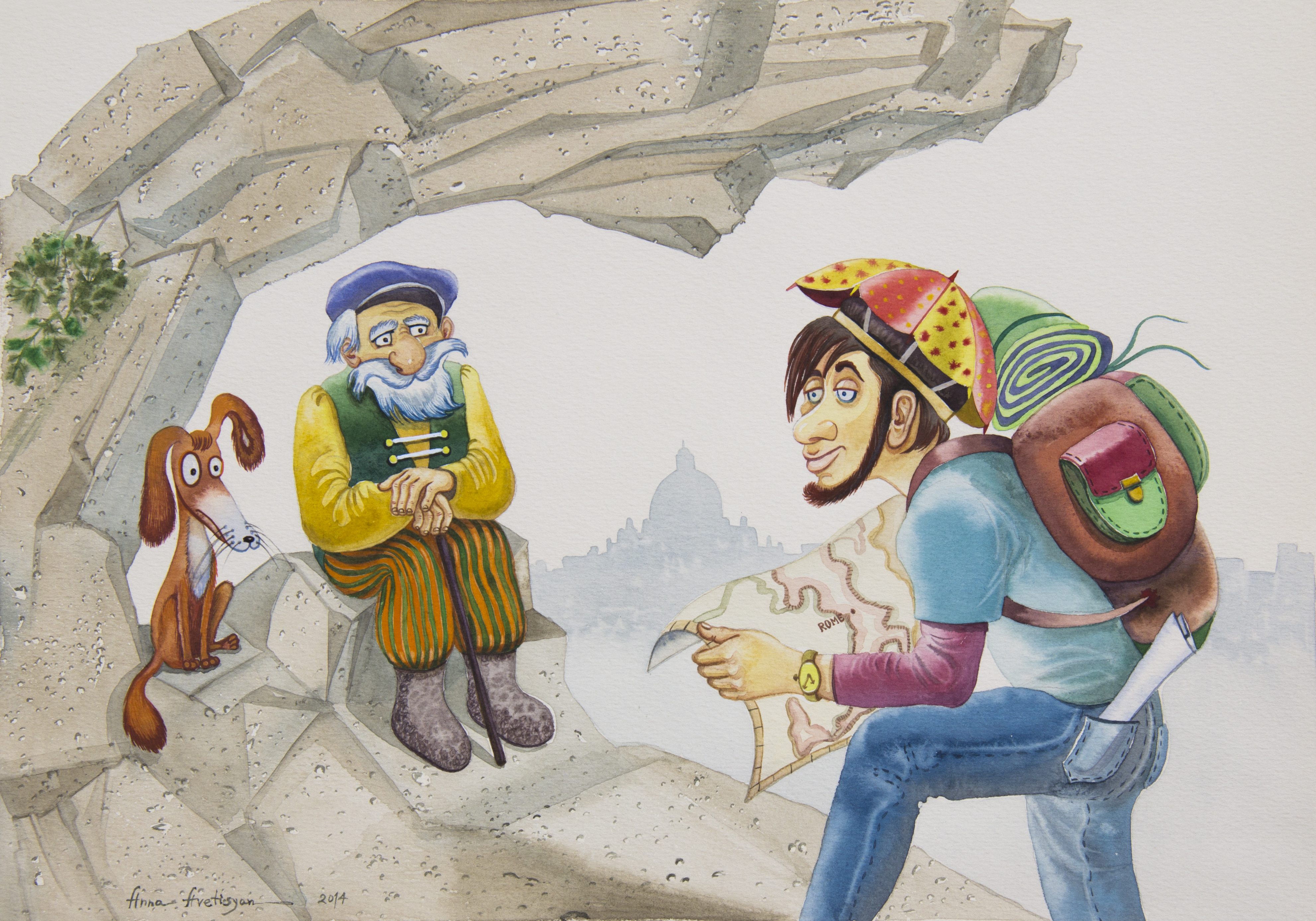
There was once a traveler who was on his way to Rome, it was a long and dusty path and he had misgivings about the city. He had heard so much, travelled so far and he was nervous about how he would make his way in the new city. A days walk from Rome he reached the top of a hill from which Rome in its glory could be seen. And sitting in the shade of a rock sat an old man. He walked over to the man.
“Wise one” he said, “ I have traveled far, please tell me, what are the people in Rome like?”
The old man looked at him for a moment and said, “Where are you from brother?”
“I am from a village outside Athens sir” replied the traveler.
“And how are the people there?”

And the traveler replied “The people from my village are generous, kind and understanding, they welcome travelers and treat all men as equal”
“Well” said the old man, “You are in luck, for the people of Rome are just the same”

The following day another traveler reached the top of the mountain, looked toward Rome, noticed the old man and walked over to him and said: “Wise one, I have traveled far, please tell me, what are the people in Rome like?”
The old man looked at him for a moment and said, “Where are you from brother?”
“I am from a village outside Athens sir” replied the traveler.
“And how are the people there?”
And the traveler replied, “The people from my village are mean, unscrupulous and lack any compassion, they are suspicious of travelers and only look after their own interests.”
“Well” said the old man, “I regret to tell you that the people of Rome are just the same.”

Image

Reflection

We often feel that a situation is bad and many times we relate this with particular events and circumstances that seem to us unique to that situation. However so many times we fail to ask ourselves if we have encountered the underlying issues before and whether it may in fact be us who is the common element. We are inclined to take our baggage with us.
I believe that wisdom is paying more attention to what is going on around us than the next person and seeing our part in this; and this includes us recognizing our part in repeating patterns. We are almost never a neutral party in anything we are a part of.
Thus for International Development we must try to see how we take our own projections into various situations, staff groups and communities. And be aware of our own inclinations to make judgments and prophesies based on our own assumptions and then to see how these tend to become self-fulfilling. Just as the travelers in the story above we tend to see our situation as being the result of others behaviors rather than the result of our own interactions with others. We expect others to be open to change and have positive mindsets when so often we fail to be genuinely open and positive ourselves. We expect others to have self-belief when we do not believe in our own power to be real catalysts for change. And we expect others to take risks and be advocate for change, when we do not take risks or challenge the authorities in our own circumstances.

Jock Noble March 2014

Jock Noble is the Lead of World Visions Economic Development Learning Hub for the Middle East and Eastern Europe. After a career of trying to teach turtles to fly he finally got into the water and is learning to swim with them.

© Words and pictures Jock Noble: Original pictures by the wonderfully talented Armenian Artist – Anna Avetisyan

 

Posted in Stories From the Road | Tagged , , , , | Leave a comment

Stone Soup

Once upon a time there was a traveler who walked all day without food and arrived at dusty village; two rows of small stone and mud walled houses with broken tiled and tin roofs each side of a stony potholed dirt track. It was hot in the early afternoon and the village smelled of charcoal fires and cow dung. The villagers sat on split log benches pressed hard against the walls of the houses or squatted in the pools of shade under the few trees in the central common near the village well. The flies were thick and tried to find moisture in the corners of the kid’s eyes and mouths and around the goats that looked for the last blades of grass and weed. Into this village the hungry visitor made his way.

The first person the traveler met was a women walking with two small  children and when he approached they clutched her skirt and moved behind her peering at him around the folds of tattered fabric. The traveler said, “Mother, I am hungry, can you spare a few mouthfuls of food?” But the woman said, “We too are hungry uncle and no one here has any food to spare, I can’t even properly feed my own children.”  The traveler knocked at the door of one hut and then another but the villagers who came to the door said the same. The visitor was travel-weary, tired and hungry he took rest for a while under one of the trees.

In the cooler part of afternoon he went to where the well was and spoke in a voice loud enough to be heard through the whole village. “I see everyone is hungry, and so I am going make a big meal and feed everyone, please come and join in the feast, this evening we will all eat well today.”

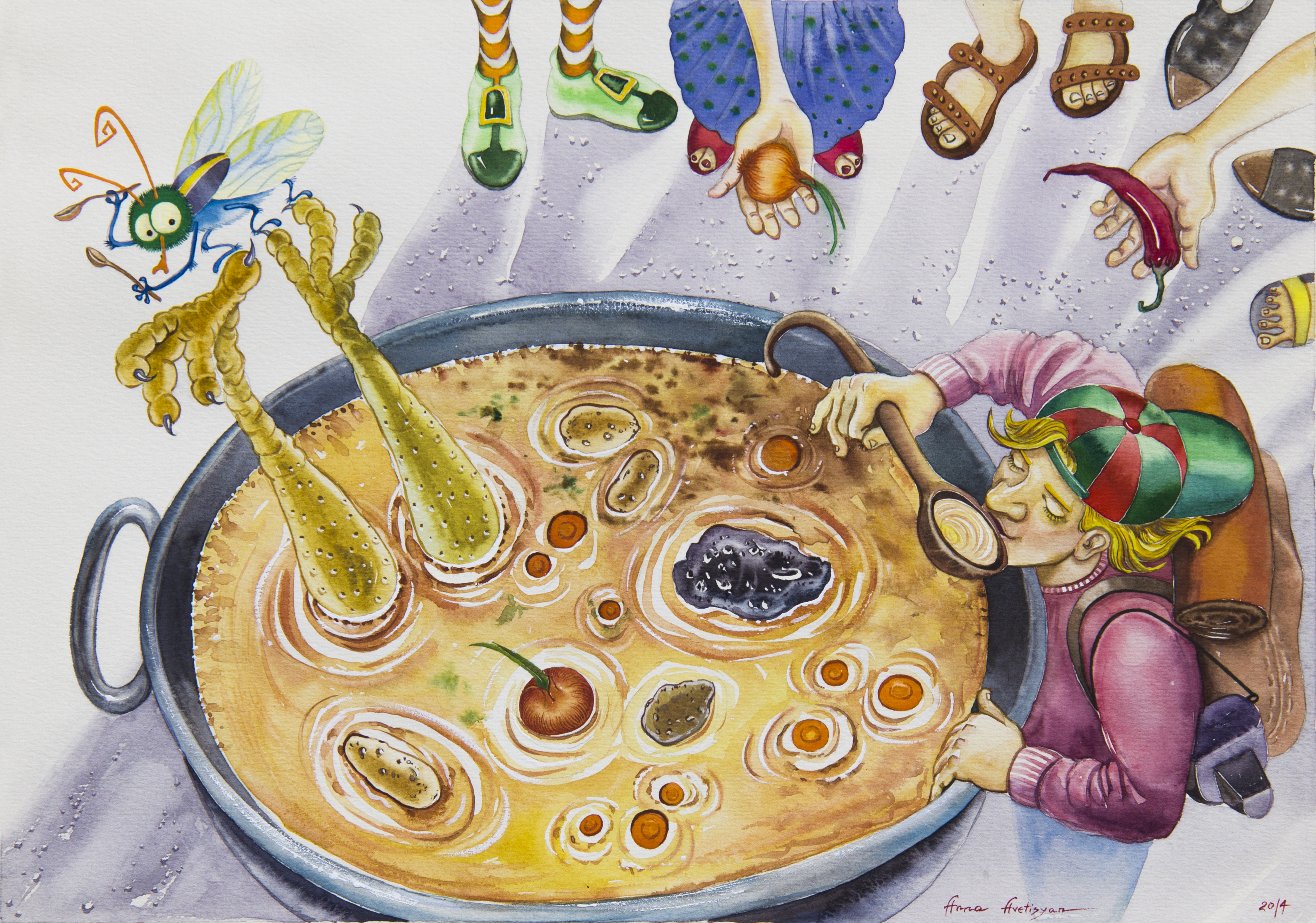
The visitor asked for the biggest pot in the village and someone brought it, he asked for some fire wood and the kids collected what they could. And the man asked the children to fill the huge pot with water and he then put it on the fire. And when the water was boiling he took out a large polished stone from his bag and announced. “I will now make stone soup!”

After some time the visitor took out a spoon from his bag and took a mouthful of the steaming liquid. “Ah it is coming along well, I think it just needs a little salt, can anyone spare a little salt?” and someone brought some. And the pot bubbled and the villagers chatted amongst themselves and waited expectantly. And the visitor again tasted the liquid. “Oh wonderful” he said, “Its coming along well, all we need are one or two onions, can anyone help with two onions?” And the onions  were supplied. And so the soup bubbled and every so often the visitor would taste the broth ask for one more ingredient, one time carrots, the next potatoes, and the next some chili and the next some corn and finally a chicken.

Image

And when the soup was ready everyone had more than they could eat and there was plenty left over.

(The story of Stone Soup has no known author, is apparently some hundreds of years old and is retold in many countries in many forms, from nail soup in Scandinavia, to Axe soup in Russia)

 Reflection

After telling this story I ask participants, what they think this story is about. And someone generally says , “It shows how when everyone works together there can be more than any one person working alone.” And typically everyone nods. And I ask what else? And sometimes someone will say something like “The traveler had to trust and believe that the villagers had it within them to respond, otherwise all they would have had was hot water with a rock in it and the visitor would have to run for his life. “

And that to me is the is the wonder of this story, that a visitor to a community would be prepared to risk himself or herself not based on a belief that their job was to be an expert or to own a success but to take a risk that other could be shown they have the answer. To have faith in the possibility that ignited belief in one person might be the beginning of fire and change a world. And this is unlikely to ever happen through a log frame for soup or a professional Power Point presentation, or some action learning or evidence building activity.

The shadow in the story is the voice of the skeptic, what in fact is the traveler really offering?  We all have our own answers to this but certainly he is offering his belief in people and he is trusting in peoples curiosity to take a leap of faith towards something, in this case a never before heard of soup. There is a magic in this and he is the catalyst of it. And the magic is performed through the courageous belief of the traveler. Of course he is hungry for a result and keen to meet his own objective to eat a meal. He is not a neutral player. And neither are we as development professionals. We all need each other and the leap of faith taken by the communities we work in, to succeed.

The traveler holds a vision, he cannot be sure how the soup will progress or what the community will be able, or prepared, to offer. And yet in the story, as in life, something can manifest from very little.

It is also significant that the traveler is the only one who is potentially putting his life on the line, he has more to lose than the villagers. They are only offering what they can actually spare. The traveler like the development professional is offering himself, his credibility, his future in that village, perhaps even his life; he is raising hopes with no certainty of the outcome.

Yet by his faith alone, in himself and in the community as not being different in essence from his own character, humility and brokenness, he is able to build and generate the trust that brings about something none of the participants could have done on their own.

In the international development context, my view is that this story is more about the courage and unshakable belief needed by development professionals than it is about communities being able or obliged to work together.

Jock Noble March 2014.

Jock Noble is the Lead or World Visions Economic Development Learning Hub for the Middle East and Eastern Europe. After a career of trying to teach turtles to fly he finally got into the water and is learning to swim with them.

© Words and pictures Jock Noble: Original pictures by the wonderfully talented Armenian Artist – Anna Avetisyan
Posted in Stories From the Road | Tagged , , , , , | Leave a comment

The Abilene Paradox

We were sitting around playing cards. It was hot, almost 45 degrees Celsius. There was me and my wife Diana and Diana’s sister Debbie and her husband Steve. There was almost no wind outside and the air was shimmering like a mirage, the tar on the road in front, was  shiny at the edges, it was beginning to melt and  the dogs were walking in slow motion dogs as though sticking to the sidewalk. The ceiling fan in the in semi dark room living room pushed the hot air around greasy like molasses. We were visiting Debbie and Steve for the first time in several years and they were trying to make sure we had a good time.

After a card game in which Debbie and I had won, Steve said, “why don’t we go to Abilene, it won’t take us much more than an hour to get there and we can enjoy the mall and have an early dinner there at one of the restaurants”. I didn’t much feel like going anywhere; I was enjoying the cards and the lazy
Saturday afternoon. But my wife spoke up enthusiastically and said that she thought it was a great idea and would get us out of the house. Debbie agreed it would be fun. So I said, “looks like we have a plan, lets go!”. We jumped in to Steve’s old Toyota Camry and set off. The air-conditioning wasn’t working and so we had the windows down but it was still like an oven and too noisy to talk.

We got to Adeline and the Mall was full overweight Midwestern couples in leisure suits, stores selling things I can’t imagine anyone needing, there was upbeat piped music, and the whole place smelled of sugar donuts. We ended up eating at a Chinese Restaurant where the food was overpriced and all the dishes tasted much the same.

On the way back none of us had much energy for conversation in the dark on long straight roads and into a barrage of oncoming headlights. It seemed all of us couldn’t wait to be home and there was an uneasy tension in the car. Then Debbie said “You know, I didn’t enjoy that at all and I am sorry I let you all talk me into it.” Then my wife said “ Well I didn’t want to go but I wanted to support Steve who was only trying to be helpful.” And I said, “I never wanted to go but the three of you had already decided.”

The Abilene Paradox

Then finally Steve also spoke,   “I didn’t really want to go but I just wanted to show you all a good time, it is not often you visit and I was worried you might be bored just sitting there playing cards.”

So it turned out that we had all taken a journey of nearly 200 kilometers, in almost unbearable heat, that none of us wanted to take in the first place to reach a destination we weren’t interested in.

Reflection

I find this one of the most fascinating stories as it relates to international development. I see it occurring in groups of staff and in community groups and especially when our staff and community groups are working together. In the last case it is because whether it is actually true or not, the communities we are working with often perceive us as having a plan, money and power and a community group essentially says, “Well if you want to go to Abilene we will come with you.”

I have probably told this story to fifty different groups and whether it is to villagers sitting in a mud floored church in some remote region in Africa, or whether to a staff team in an office, it has never failed to cause laughter and exchanges of knowing looks. When I ask them about the story, group members always confirm that they have been to ‘Abilene’ many times.

In the case of international development organizations one of the dominant considerations is minimizing the risk that the donor’s money will be wasted. This has encouraged mindsets and systems where minimizing risks often seems to be more important than taking risks to make a situation better. Over many years of development there has been a push away from inspired individuals, perhaps characterized by the passionate or even slightly mad missionary, in favor of a professional and scientific approach. This can lead us to a ladder of interference that often carries within it at least one false assumption. Which means that whole ladder is flawed.

As an example, a simple form of this thinking is:

People in the developing world are poor,

If they had money they would be happier and healthier,

What they need is money,

Money will solve their problems,

Let’s raise money.

Or in a more nuanced example, we are visiting a poor village where the people have little money and their children are suffering.  We look for data, we notice there is no power, running water and primitive farming methods.

Then we look for more examples of how we think the lack of technology is trapping these villagers in poverty

With this filtered view, we start to add meaning to our data based on our own experiences and beliefs….we may think, ‘ if they had more technology their incomes would rise and they would be healthier and happier and be able to care better for their children.’

Then we draw conclusions based on our own experiences – technology is key to my personal productivity, all these people need is technology to increase their productivity and their incomes and be able to care better for their children.

We then adopt these beliefs…..if we raise more money for technology children will benefit.

Then we take action – ‘let’s start a fundraising appeal to solve the problems faced by these poor villagers so they can acquire technology and their children will be happier and healthier and have better futures.’

International development is littered with examples where a flawed ladder of inference has led to poor results.

The reason for raising this in the context of the Abilene Paradox is that in international development, we are more inclined to hire people who can fit in and be part of a team and work to a prescribed plan, based on a ladder of inference, as a team of professionals, rather proactively encouraging diverse thinking by the people who are closest to the ground in generative options for change.  It is also true that in developing countries we are inclined to hire staff who share a common “compliance” worldview.

This leaves us very vulnerable to suggesting trips to Abilene and taking communities with us. Whether it is a villager in a poor village or one of our staff, not going along with the plan can be perceived as disloyal, obstructive and hurting people who are poor.

In a village there is often a hierarchy based on clan,  wealth, age, power or politics and I have often noticed, that irrespective of the discussion, there will be one man who speaks and even though I know that many don’t agree with his opinion they will all end up supporting him. Never is this truer than when electing the head of a community group. I have spoken with all the other members of a group individually and they will all agree the person they have elected as chair is not the best person for the job yet they elected him none the less.

I have also seen staff putting forward a plan, that may well be a trip to Abilene and everyone unanimously agrees with the plan, yet the staff individually have doubts and done really have much hope that the planned results will be achieved but they feel they have no choice. And the villagers will also say that they doubt things will go as planned but if the development organization thinks that this is a good idea then they are happy to make the journey and see what happens. What transpires, is that the community group begins to show low motivation, members come late to meetings or miss them altogether. My belief is that this is because the collective group embarked on a journey that no one wanted to take, but everyone wanted to please everyone else and there didn’t seem to be a better alternative at the time, so off they all went to Abilene.

The beginning of the Abilene trap is that staff or community members fail to clearly communicate their desires or beliefs with each other. And actually do the opposite; expressing enthusiasm for an idea thereby leading each other to misperceiving the groups shared beliefs. So it is then natural that this collective misperception will lead the group to make decisions and embark on actions that their heart is not in.

Predictably, rather than leading to strong collective action this paradox is more inclined to lead to frustration, demotivation, blame sharing, undermining, anger and disassociation with the group or process. At its core the Abilene Paradox has to do with a groups inability to manage a process of open communications, manage different points of view, and manage a way to find a shared agreement.

Underlying the Abilene Paradox can be the fantasies held by group members. The international development staff team may believe that the donor or the organization will not tolerate the longer time frames that might be required to manage a more complex agreement process or that there is no way through organizational bureaucracy or that the team is in common agreement…… except for them. The Community group may believe that the development organization has a fixed idea of what needs to happen and so try to anticipate what they think is required of them in the situation. Either group may have a collective belief in their own powerless.

In many cases what is likely to be at the core of the Paradox is each member’s fear of separation from the group, of isolation, alienation or ostracism. Members might feel that to voice their own views or feelings will be perceived as disloyal, obstructive or not being a constructive team player. In fact agreeing outwardly but disagreeing inwardly has the very effect that the individual was trying to avoid. They are now frustrated and feeling alone with a decision that they helped create!

For me the first step of “bypassing” Abilene is to understand the existence and danger of the Abilene Paradox in the first place. I believe it is vital to separate the process of gaining points of view from managing the process for finding agreement. The second step is to find ways to ensure that genuine diversity of opinions is encouraged by broadening the parameters of the discussion before becoming more focused. One way to do this is to brainstorm twenty or thirty different points of view before again narrowing by beginning to group them into “buckets” of interests. The next step is to try to describe the diversity of views the multiple realities and “truths” of the situation and  creating an environment that holds the possibility for a genuine shared way forward that avoids a trip to Abeline.

(This is a retelling of the original Abilene Paradox story Professor Jerry B. Harvey Phd, and my reflection also draws on theory from some of his writings.)

 Jock Noble January 2014.

 Jock Noble is the Lead or World Visions Economic Development Learning Hub for the Middle East and Eastern Europe. After a career of trying to teach turtles to fly he finally got into the water and is learning to swim with them.

© Words and pictures Jock Noble: Original pictures by the wonderfully talented Armenian Artist – Anna Avetisyan

Posted in Stories From the Road | Tagged , , | 1 Comment

The Bear that Enjoyed Reading

The Bear that Enjoyed Reading

In olden times bears were worshiped by humans.  They were often used as symbols of the Christian church because  they were clever, powerful, wonderful climbers and fast runners. Because of their many attributes there was once a man who set about trying to teach a mountain bear to read. He spoke to the bear at length about the advantages of reading and how the bear could earn a better living if he could learn from books. The bear sat quietly and listened to the man. The bear could tell the man was very convinced of his argument and the bear felt sure that if he just sat quietly and pretended that he understood whatever the man was talking about then he would get some kind of reward.  To thank the bear for listening, the man gave the bear a small pile of raisins. After some time the man gave the bear a book but the bear didn’t know what to do with it. So the man put a raisin between every page, and the bear liked the sweet raisins so much he turned every page and found another raisin. The man was very pleased because the bear was now holding the book, looking at every page and then turning to the next page.  The man was sure that this was just the encouragement that the bear needed to begin to learn to read. When the bear got to the last page and the last raisin and was sure there were no more raisins he threw away the book disappointed and lumbered back into the forest to look for more food.

(This is a retelling of an old Armenian fable)

 Reflection

In International Development we often find ourselves embarking on something that someone, somewhere seems to think is a good idea and will benefit people’s lives. Mostly we focus on the external drivers and the manifestation of concrete, visible change as the indicator of success. We assume that seeing external change means that there is some kind of corresponding “internal” change, a change in the way people who are poor see things and make sense of their world as demonstrated by their actions. But the priority of getting external change often leads to us only focusing on doing those things that will make it seem that change is taking place. And as is the case for the man in the story, we can be blind to what is really going on. In order to see external change the man effectively bribes the bear to take the action he desires, as though the external action will lead to internal change. But in fact, it is almost always the reverse. But if, like the man, you are looking for fast results and what you do if offer the equivalent of raisins, it will be inconsequential and not contribute to the desired change. The only way the bear is ever going to read is if he has the capability to read; even if he can he needs the motivation to determine that learning to read seems  like a genuinely better option than his other alternatives. Clearly, in the story, neither is the case. In International Development, as often as not when the project finishes and the funding runs out, a community reverts back to what it knows, just as the bear did, because only the external manifestations of change, driven by one form or raisins or another, were present.

Jock Noble is the Lead or World Visions Economic Development Learning Hub for the Middle East and Eastern Europe. After a career of trying to teach turtles to fly he finally got into the water and is learning to swim with them.

© Words and pictures Jock Noble: Original pictures by the wonderfully talented Armenian Artist – Anna Avetisyan

Posted in Stories From the Road | Tagged , , , , | 19 Comments

 The Kings New Clothes

The Kings New Clothes

Once there was a proud king who spent much money on fine clothes so that all could see that he was indeed a man of great importance. He spared no expense to keep his reputation as someone who always wore the finest clothes and stood out at every occasion.

One day two swindlers came to the city. They said they were fine weavers and master tailors and knew how to make clothes that were beyond the imagination of ordinary men. They said the clothes they made were so soft and fine that they might have been made of spider web, that the colors they used were so extraordinary that they may have come from the feathers of a peacock and they had the amazing property that anyone who was stupid or incompetent could not see them.

The king who was always looking for something new to impress the citizens of the city was captivated and enthusiastic to have a suit of clothes made for the upcoming parade. Also he thought I will be able to tell which of my ministers and advisors are incompetent and I will be able to tell the clever people from the stupid ones.

So the king paid the tailors a large deposit and they set up their weaving looms and pretended to set to work, often working late into the night.

After a few days the king sent his most trusted Minister to see how work was progressing as the procession was less than a week away.

The minister went to the rooms where the swindlers were pretending to weave the thread for the clothes but he couldn’t see a thing. “Well” said one of the swindlers, “isn’t this the finest cloth you have ever seen?” But the old minister could still see nothing. “Goodness” he thought, “I can’t see a thing, am I stupid and unfit for my position?” So he said “This fabric is the most beautiful I have ever seen! Magnificent colors and the patterns are superb, the king will be thrilled!” The swindlers then went into detail naming the patterns and describing how the colors all fit together to create an extraordinarily effect, so that they could be sure the Minister would report all this to the King.

When the minister returned to the king he said, “Your majesty the colors are amazing, the patterns sensational and the quality of the thread beyond belief.” So the king was well satisfied and waited in expectation.

The king sent other ministers to follow the progress and each returned to the king with reports filled with words like ‘Amazing!, Excellent! Magnificent!’

The night before the procession, the weavers stayed up all night pretending to sew the garments and everyone could see they were working feverishly to finish them on time.

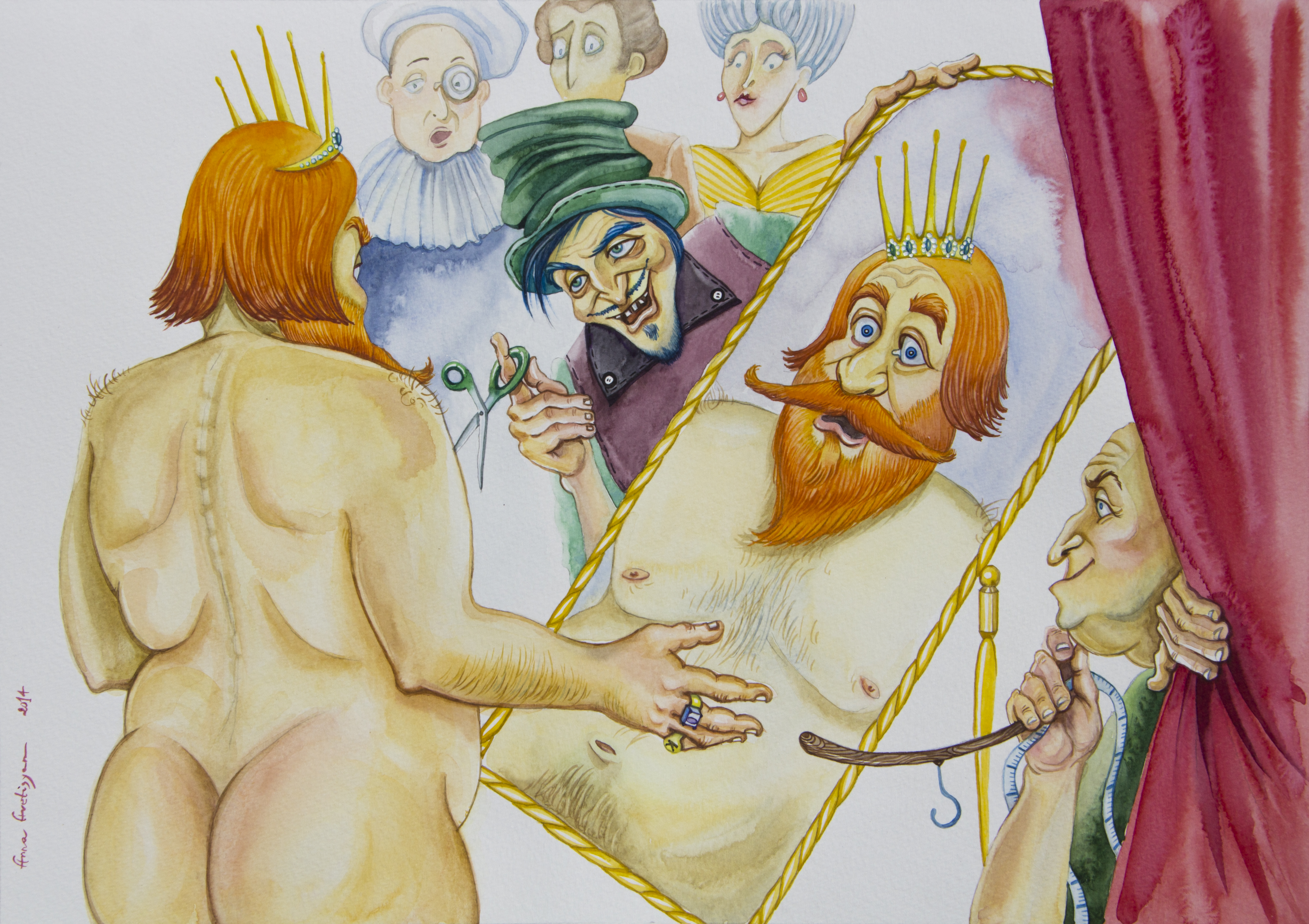
The day of the procession, he weavers carefully brought the imaginary clothes to the kings dressing rooms and asked him to undress. Then they carefully set about dressing the king, firstly helping him put on the imaginary trousers then shirt and waste coat and cape, saying as they did that the exquisite lightness and quality of the fabric and the care of the tailoring meant that it may feel to the king that he was wearing nothing.

Then the swindlers stood back and admired the king, “Oh your majesty, you look wonderful, the colors are amazing, the patterns, works of art, the clothes fit you perfectly, what a luxurious outfit!” And they turned to the king’s servants who clapped and nodded enthusiastically in appreciation.

The king looked at himself in the mirror and had to pretend that he could see what apparently everyone else could see and he smiled and nodded with great appreciation.  The king’s servant picked up the imaginary train of his cloak and held it up with great ceremony so as no one would suspect that they couldn’t see anything either.

And so the king went out onto the great steps and under the canopy that had been erected, he was  surrounded by thousands of his subjects who were also waiting expectedly to see the marvelous new clothes for all had heard of the miraculous suit being made for the occasion.

While all the attention was on the king, the swindlers took the gold they had been given in many payments and all the fine silks that had been provided to them for the work with and that they had hidden away and quickly left the town without anyone noticing.

Everyone was commenting on how magnificent the king’s clothes were. For like everyone else no one wanted to appear incompetent or stupid. Then a small child came looked up, saw the king and called out, “the king is naked, he has no clothes!” And suddenly everyone knew it to be true. But the king was a proud man and he continued to march through the streets as naked as the day he was born.

This tale was made popular by  Hans Christian Andersen (1837). Andersen’s source was a Spanish story recorded by Don Juan Manuel (1282-1348). The tale also has its equivalents in Sri Lanka, Turkey, India and England

Reflection

This story illustrates many things, particularly how a chosen belief system, as flawed as it may be, can survive when everyone agrees to maintain an illusion for in many cases the status quo makes more sense to the people involved than their alternatives as they see them.

Often in International Development a project does not go as well as hoped and intended. Development is a messy business and there are so many factors that can lead to outcomes that are lower than expected or circumstances which add unforeseen complexity. I have been involved in many projects where we have all realized that we need to change our activities or approaches. The place I always start, whether it is with a group in a community or a group of staff, is to ask what is working, what is not working and what would we like to do differently? Surprisingly, even though all is not going as hoped and everyone involved can talk about the problems encountered, as often as not, people say that nothing should change and we should just give things more time and redouble our existing efforts. In a sense this is, like the king, deciding to march on naked.

It seem obvious that, for us to try to make changes,  we have to admit there is something that needs changing and here the road can begin to get sticky. To admit that something needs to change means that we must in some sense admit to the at least partial failures in what we have been doing.

The king in the story had been “working with expectation” on his new outfit for some time and when faced with the choice of changing his strategy and admitting that his assumptions and faith had been in fact been stupid, and with this worst fear realized, he elected instead to continue with “the project” and march through the streets naked, even though it was obvious to all that the new clothes project was a failure. It is interesting to surmise whether on meeting the naked king in the street, any of the subjects would tell him outright the new outfit was not working. Or whether in spite of the previous disclosure of a serious problem with the plan, everyone would inadvertently conspire to maintain the illusion. And thus nothing would change.

In this story, everyone has something to lose by admitting that they made a mistake, so in a certain way it makes sense to continue with the illusion. Development psychologist and author Robert Kegan[i] calls this ‘immunity to change’. Kegan describes how often it can seem to make more sense to do what we are doing even when we are failing relative to our aspirations rather than make a personal change to better meet our stated goals or mission.

So for example, the king is proud and doesn’t want to admit that he is wrong so he decides to stick with the program and march naked, as this in some ways better meets his need to be perceived as right rather than to admit he was wrong, change his plan and adopt a new set of clothes.

Kegan describes how our hidden commitments or assumptions are very often the things that drive our behaviors and the actions we take are those that are consistent with these hidden assumptions.  In many situations the actions required to meet our lofty and genuinely held and stated beliefs would require actions that were in fact inconsistent with our hidden assumptions.

Several years ago in Africa I observed that a displaced persons camp had sprung up in the area the NGO  was working in. It transpired that even though there were hundreds, perhaps thousands, of children living in this new village of makeshift tents, in the dry scrubby hills, the NGO was not actively involved in doing anything to improve their lives or assist the children attend school or their parents access basic services. It was not through a shortage of funds; apparently nothing was being done because it was not part of the NGO’s plan for the area. The manager held an MBA and was bright and efficient and the staff teams committed to the organization and morale was high. Every morning at devotions they all read out loud  the stated values of the organization together which were pasted on the wall: “we are child focused, we are committed to the poor, we are responsive, we value people and their right to freedom, justice, peace and opportunity”. At the time I asked myself, how can it be that these staff are so sincerely committed to these values and yet are not trying to respond to this obvious need on their doorstep? I think the answer lies somewhere in this concept of ‘immunity to change’. How the ‘self-identity body’ can seek self-preservation – like an immunity reaction – and only take action when it is consistent to the hidden commitments and assumptions or operating system of the person.  So in this case I surmise that those, who could have taken responsive action,

were working within a world view something like the following: “we will be more successful if we stick to the plan; change often involves risk and this may work against me; my manager and those above will not appreciate the additional workload and changes that being more responsive to this situation will entail; I need to show I am focused on the existing plans”. And behind this world-view is likely to be a hidden assumption something like:  “I will succeed if I don’t take risks and don’t leave myself open to blame”.  With this hidden assumption largely fixed and unrecognized, personal change and action, regardless of any espoused principles, is unlikely to take place.

This concept can apply to the group of staff who will  take 30 minutes and convincingly describe what is not working in a project, and when asked: “So what should we do? What would you like to do? “ The answer as often as not is, “let’s work for another three years doing the same things we are doing now, all we need is more time”. If the hidden assumption is, “my whole identity, standing and perhaps future livelihood and success is given to me by this community that I am working in”, then to take some steps that risk strong resistance by some vested interests in the community may mean that as much as the staff member is committed to the project’s success, his or her hidden assumption is a stronger driver than any genuinely held but inwardly inconsistent beliefs. When I say inwardly inconsistent , I mean not seeking to change a project, even though it is failing, may very well be much more aligned to the staff’s hidden assumption,  than to change the project and risk having some in the community withdraw their personal support.

I have often found myself telling this story of the proud king to groups of staff. My intention is that until we can say that the king is naked, or the project is broken and to see that we too have a role in this story, it is almost impossible to gain enthusiasm to make changes that may lead to better outcomes. The king’s foolishness was not his alone. There were many in the story of the king who could have spoken up early and the king would have jailed the swindlers and started again. The illusion of success was supported by the hidden assumptions of the Ministers who feared they actually were incompetent and whose hidden assumptions may have been, “I will succeed if I tell the king what he wants to hear and appear clever at all times.” If this was the hidden assumption or commitment, then telling the king the clothes were superb, against all evidence, made a kind of sense. Mostly, people understand our need to disclose program challenges but when it comes to getting to our own role in that, the path suddenly becomes steeper and rock strewn. One staff member in Eastern Europe said they were offended by the mental image of the naked king, another group in Timor was in tight agreement that the king should never have been a king in the first place and if he was so stupid why did the subjects follow him? And in neither case did we make much of an inroad to what we might choose to do differently and what this might mean for changes in behavior of the individual staff members involved.

I am convinced that to make real changes when a program is struggling, the place to start, is to find ways in which the key players can find a way to feel safe to explore and disclose their hidden operating assumptions. It is my view, that these hidden assumptions are both a product of personal worldviews and paradoxically foundational for them and, unless these change, the likelihood of significant program changes is small. From time to time I have seen this happen in individuals and as a result there have been astounding changes in the ways they do things and the results that take place. More often I have seen the negative consequences when, in spite of overwhelming evidence of the need for change, things continue the same and as king, we continue our naked march.

[i] Kegan, R. &. (2009). Immunity to Change. USA: Harvard Business School Publishing.

© Words and pictures Jock Noble: Original pictures by the wonderfully talented Armenian Artist – Anna Avetisyan
Posted in Stories From the Road | Tagged , , , , | Leave a comment

The Saint’s Tooth

The Saints Tooth

Once upon a time, there was a village where the people were very poor. There were many reasons for this. The ground was hard clay and covered in small iron pebbles. In the dry season top soil became a fine dust and the hard clay on the tracks and hillsides dried and cracked. Often in the summer months the wind picked up the dust and carried it into the people’s huts and into everything they owned. The summer heat made thermals and the grey dust spiraled upwards in mini tornadoes that in the local language were called “the angry person”. And in the wet season the rain came in torrents and turned the walking tracks and roads into rivers and the dust became mud and each year more of the scarce top soil was washed away. Because the people were so poor they progressively cut down the trees on the surrounding hills to use for fuel to cook their food and boil water. The villagers grew as much corn and vegetables as they could and kept a few goats to milk for their children. In the previous year the rain came early and then stopped and the crops which had begun to shoot died and there was no time then to replant, so now there was hunger in the village. There had also been feuds and land disputes between villagers which went  back many years and the people did not trust each other and only worked together grudgingly.

The chief was a wise man and realized that the people’s lives would only improve if they worked together and built an irrigation channel from the river that was over a kilometer from the village. But the people couldn’t agree how to share the work and many thought that those who had land closer to the river would stop their labor once it had reached their land and so the work was never started.

One day the chief called a strong young man and said “We need a miracle if our village is to survive; I want you to go and find a holy relic and bring it back to the village so that we can pray to it and God will bless us and we will be saved.” So the young man went off with all the food he could carry in search of a holy relic to bring back to the little split logged dirt floored church.

Initially the villagers were hopeful that the young man would return but several months passed and there was no sign of him and soon he was forgotten.

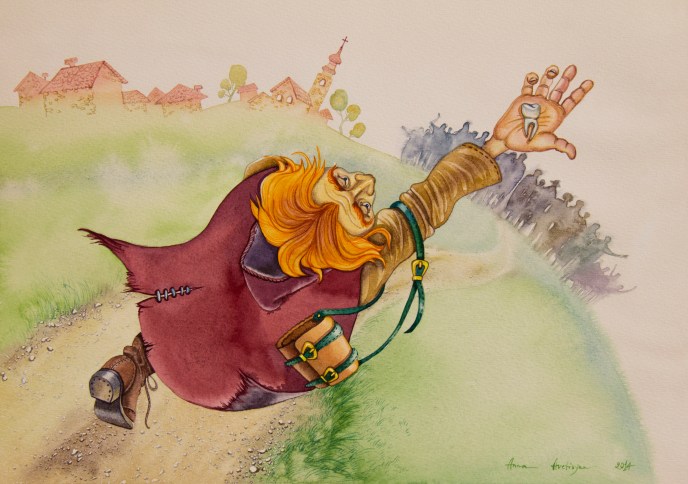
The young man, faithful to his task travelled the county searching for a relic from a saint, but his food had long run out and he lived by scavenging what he could. Eventually in a barren place, weak from hunger, he tripped and fell. And next to where he fell there was the carcass of a dog. In desperation he pried one of the teeth loose from the dogs jaw. In a few days he returned to the village with the tooth. He told the whole village of his search and his eventual success in finding the tooth of a venerated saint. The villagers took the tooth and together built a case in which to display and venerate it in the church.

Now when the villagers came to pray at the church, they felt they were in an especially sacred place. Together they felt their village was now special as it was the home of this sacred object. Some people said that they had their prayers answered and others said that they had seen the tooth glowing in the dusky half-light of the church.

The chief again called a meeting to discuss the digging of the irrigation trench. Now there was a different mood amongst the villagers. Seemingly there was a certain unity as they now saw themselves as the village of the saint’s tooth and blessed by God, where as previously they only thought of themselves as a poor cursed village.  Now they felt that they were unified as the only village in the area that had a relic from a genuine saint.

It was not long before the chief was able to organize a team to begin work on the channel and they decided together that they would all start the trench from the furthest farmers land and work back toward the river. And within a month the trench was dug, the water flowed; the villagers built bonds of trust and friendship that had not existed before. Some said it was a miracle made possible by the tooth of the Saint but others wondered why they had not been able to work together all along.

Reflection

I have told this story numerous times when trying to generate thought and discussion as to  how when we believe that something is possible, that it often is. This is a story about the power of faith and hope and also how we create our own reality,whether we live in the cursed village or the blessed one, the future is in our hands or rather our heads. It is about the realization that we live in mystery and, in this mystery, the hope that we can make a difference in our own situation.

On one memorable occasion I told it to a group of poor Muslim farmers in Senegal and they had absolutely no idea what I was talking about. I remember well my colleague at the back of the room looking up at me from her laptop and I could see she was thinking, ‘can’t wait to see you get out of this one’. As is my habit I kept digging myself a deeper hole for a while before just giving up in front of the very respectful but perplexed audience. I think what I failed to do was to make the link between their current situation as they saw it, their fate, and the possibility that a different future was possible. This required a shared belief and, based on that belief, a shared hope; what could be their Saints tooth?

It is a fact that some towns or neighborhoods prosper and others in similar situations struggle socially and economically and even disappear. What is it about their faith and how this links to  hope and then action for a future which results in success? Believing in something outside ourselves is generally called faith and often it is this faith that allows us hope and in turn the motivation to work towards a different or better future. I am always encouraged by the following words by the esteemed late Czech playwright, essayist, poet, dissident and politician Vaclav Havel.

“Hope is definitely not the same thing as optimism. It is not the conviction that something will turn out well, but the certainty that something makes sense, regardless of how it turns out. In short, I think that the deepest and most important form of hope, the only one that can keep us above water and urge us to good works, and the only true source of the breathtaking dimension of the human spirit and its efforts, is something we get, as it were, from “elsewhere.” It is also this hope, above all, which gives us the strength to live and continually to try new things, even in conditions that seem hopeless as ours do, here and now.”[1]  

Jock Noble November 2013,

Jock Noble is the Lead or World Visions Economic Development Learning Hub for the Middle East and Eastern Europe. After a career of trying to teach turtles to fly he finally got into the water and is learning to swim with them.

© Words and pictures Jock Noble: Original pictures by the wonderfully talented Armenian Artist – Anna Avetisyan
[1] Václav Havel in Disturbing the Peace: A conversation with Karel Hvížďala, (Knopf, 1990), p. 181. Originally published 1986. Translated from the Czech by Paul Wilson. Also available in The Impossible Will Take a Little While: A citizen’s guide to hope in a time of fear by Paul Rogat Loeb, (Basic Books, 2004), p. 82.

Posted in Stories From the Road | Leave a comment