Mr Morongo

Helicopter of Christ

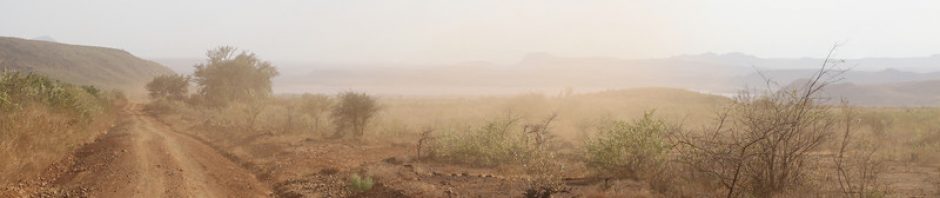
About six months ago, Mr. Kibani  found himself in a taxi going to a dowry wedding with Mr. Morongo who at around 62 was getting married for the third time and then going to jail. The men were both Kikuyu, they taught in the same primary school until each retired and they had remained neighbors and friends. Mr. Morongo had helped start the Kasuku primary school almost thirty years ago and stayed on teaching until three years ago. Kasuku village is surrounded by the rolling, mostly green hills of Kikuyu heartland. In Swahili Kasuku means parrot. Mr. Morongo taught Mr. Kibani’s seven daughters and two of his three sons and now, except for the youngest son who was still at college, they were all grown up and married. Mr. Kibani was happy with his children, they showed respect and contributed to family projects like buying him a new suit and his wife a new bed and even funding church projects that he lead. They both went to the Helicopter of Christ Church on the Gilgil road in Kasuku.

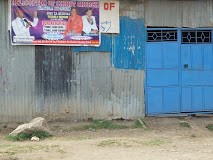
If you left out the churches Prophet and the congregation, the  Helicopter of Christ was actually just a corrugated iron shed, some of its corrugated iron walls had been painted sky blue and it sat on a large dusty plot surrounded by prickle bushes. Above the entrance door, painted straight on the iron there is a red cross and to one side a vinyl banner with  Helicopter of Christ in large red flaming letters and then the opening hours and a cell phone number for private appointments and underneath a picture of Prophet Gilbert Gatonga in a white suite and the Prophets wife and another lady. Inside the church were rows of wooden bench pews, the windows had no glass but welded reinforcing mesh for security which had timber plank shutters which were only opened on Sundays. During the week it was dark and lonely inside. Beads of bright light made shafts through stray nail holes in the tin sheet walls in in the roof. And there was bright daylight surrounding the door and window frames like the second coming was in full fling outside. On the alter were plastic doilies and plastic flowers in Chinese vases all looking so sad. But on Sundays they were resurrected, a true celebration of life and nature and all that is good.

On Sundays the church was alive, and the service might go on for four full hours if  Prophet Gilbert Gatonga was particularly filled with the Spirit. On Sundays the church was filled with heart and voice and people sang so loud and danced and were seized by the Holy Spirit and fainted into eager arms and it all got mixed up with polyester best shirts and suits and body sweat and cheap perfume and new do’s of braided hair extensions and colors so if you didn’t know a women so well you wouldn’t recognize her straight off. It was here that Mr. Morongo had married his second wife.

As Mr Kibani tells the story, “Mr. Morongo was married with five kids but there were issues. It was said that the wife was a devil worshiper. It was said that she was sending people to the husband with letters written in blood telling him funny things. And there was a time when he was walking back from the small shabby town nearby and he passed some people who were sitting on the side of the road, they asked him “Did you receive our letter?” But  before Mr. Morongo could even think it, the guys were gone. Well that’s the story and there were some other things happening as well. So Mr. Morongo and his wife parted ways and got divorced, well actually she fled. That was in 1996 and really this was the only solution.”

Mr Kibani straightened the brim of his hat and continued “Soon after, Mr. Morongo married again and they had another 6 children but this wife was sick and in the last 3 years before her death she was always in and out of hospital and people were wondering why is she always sick. And they were saying it was maybe HIV but no one had the proof and people were wondering how come she was sick but the husband never showed any signs of sickness. So she passed on last year around May leaving Mr. Morongo with their sixth child who was just 3 months old.

So my wife you know and my daughters, we were all feeling for him, him being their teacher and with all the things that had been happening to him with all the small kids. He was a man of the people, people liked him, even though when it came to teaching, everyone said he wasn’t that good. But he was very knowledgeable and had all kinds of different stories that were really of interest to the students, but when it came to teaching itself he was not that good but still everyone liked him so much. As soon as the wife died he remarried again for the third time to a woman who already had two kids. So they married but it was not formalized and so that was why I had to go to the dowry wedding. He probably has HIV” whispered Mr. Kibani, “because people were saying that before the second wife even got sick that Mr Morongo had HIV. And later on the baby that he had been left with also died. But the other kids are fine.”

Mr Kibani’s rubbed his forehead hard and continued “Just before the second wife passed on he had retired, and taken his pension. He tried to become a local councilor but he lost at the election, which was a big blow to him as he had spent about half of all of his pension money on the attempt.  If he had he been elected then his future would be secure as there was always money for roads and community projects and lots of ways to keep some of the money for the councilors involved. His election attempt had been an investment in his future. It is just what the politicians are doing all over Kenya, they invest their money in the elections and if elected they can pay themselves back tenfold. So he lost. Most people who take a pension invest the money in improving their home or their land but he didn’t do any of that. So it hit him very hard with the loss and the loss of the money. At some point he became involved in a nearby flower farm. There was a time when a local guy was stealing stuff from that farm and bringing it to him and he would sell the things in the town. And he was caught. It was not that he was so dishonest but the thing with losing all that money he got a bit funny. And he wasn’t feeling himself and the condition of the wife and of the money. So he went to remand and then to prison for around 4 months. So the new wife now has seven children to care for. But a few are old enough to take care of themselves. Mr. Morongo is 62 or 63 and his hair had gone grey from the stress and he is bound to die young as he has left so much trouble behind. The third wife has started a simple  little day school but no one seems to know how it is going or how she will survive. So that is the story of Mr. Morongo, poor fellow.”


Posted in Postcards | Tagged , | Leave a comment

Towards the End of Summer

Postcard from the Black Sea

It was towards the end of summer. Liezel and I drove towards the Georgian boarder, it was before we were married and she had to leave Armenia and then re-enter with another four month tourist visa. We decided to make the trip a holiday and stay a few nights on the Georgian Black Sea coast near Batumi. On the way to the border we pass through small Armenian roadside towns’ boxy cinderblock and concreate houses with cracked walls and broken roofs and windows and doors with angles from a kids drawing and now beyond care and hope. They are on dirt potholed side roads with drainage making muddy patches even though its dusty summer. And on chimneys and the tops of electrical poles stork nests the size of truck tires made from sticks. These are the baby delivering white storks, I saw them in the spring standing in their nests often with one or two grown babies of their own, their wings and bodies tipped with black. Now they are just in ones or twos waiting to return to India. In Western Europe these storks fly up from sub-Saharan Africa and some of those arriving in Germany have been found nesting with African arrows still in them. The Germans call these Pfeilstorch or “arrow stork”. I can’t quite put my finger on it but for me there is something very moving about a bird that flies thousands of miles with an arrow in its neck to nest. I think it is something about the choicelessness of doing that thing that must be done. And that maybe too often I think I am too clever to do that thing and find a way to do another more comfortable or distracting thing instead.

"                               "

So we get to the flat land desolate border crossings at Bavra, its hot and dry, exit Armenia enter Georgia, they stamp us through.  On the Georgian side we go on to pass through few towns over the next hour, old Russian looking yet chaotic and lonely as a bag lady’s shopping trolley.

Then out of Akhalkalaki, winding decent and driving with a valley of Ash and Birch, Oak and Dogwood random and perfect along the banks and river flats of the fast flowing rock jumping stream. And around a corner on the other side of the stream, a mediaeval stone castle on a high cliff. And I feel like a stranger and part of it all the same; somehow big for being there and small as a grain of sand when I think of the lives and lives that a thousand years ago lived in the castle or grew grapes on the long abandoned terraces on the hills opposite and of this dust of their important lives. And the 50,000 people who lived in the now abandoned cave city of Vardzia just off to the west, gone.

We take a detour about four kilometers up the steep valley wall to the little village of Saros. And high on an overlooking cliff we find the 7th Century monastery of The Archangel.  In the churchyard are a couple of young nuns with cheeks the color of robin breasts , long black hair and flowing black habits wielding big grim reaper scythes  through long yellow dry grass. Leaning back they carry stacked armfuls of straw to stone stables behind. I want to take their photograph but they motion me no.

"                               "

Stones at Saro

We go the edge of a cliff amongst stacked stone fortress walls some stone blocks three meters long, built by giants maybe a thousand years before Christ. Looking out, as high as eagles into the deep hazy valley below, I feel I am passing through life faster and faster, racing headlong towards death. Beyond boxes of books, thrift shop clothing ad bric-a-brac, what I will leave and for whom. And even now after all these years I think I should know what my legacy should be and I don’t. Maybe it was the scythes that got me thinking. They open the church for us and we can smell the damp of a thousand years and a thousand years of footfalls on the step and a thousand years of fingertips stroking the monk carved crosses in the stone walls and we light candles and gaze at ancient icons of the Archangel Michael in the half light.

That  night we stay in the fortress town of Akhaltsikhe and next day head off to the Black Sea across the mountains though the Goderdzi Pass in Ajaria on an unmade creek bed road. We forded small rivers from roadside mountain waterfalls, hung on to the sides of forested mountains far above a rushing mountain river. We stop, all around mountains, a carpet of thick dull green conifers and there in the middle, maybe a kilometer away in the valley a red leafed tree, crazy beautiful for its difference. Our location is just near the border of Turkey and was settled by Greeks 2500 years ago.  The red tree bothers me, if this was a person in the developed world, we would put them in a mental institution.

We reach Kivariati on the black sea coast in the afternoon, grey sky, grey misty sea, raining and humid.

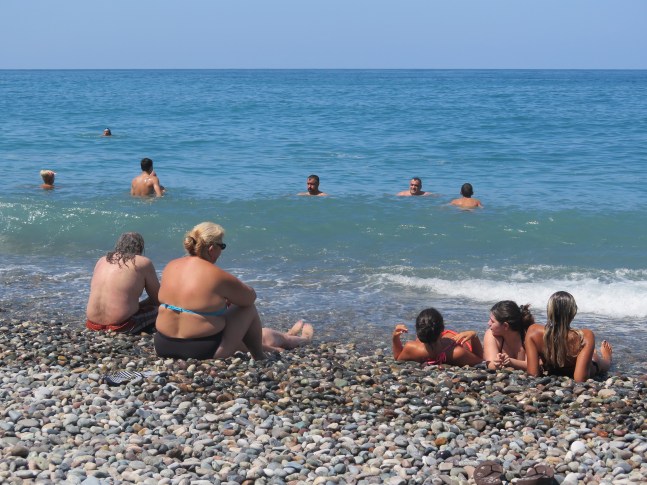
Next morning is sunny and clear. The ocean is sky blue and throwing up a small surf. The beach is a billion rocks most are oval and smooth the size that fits in your palm and you want to take it because it feels precious and unique but so is the next and the next and they are green and gray blue, deep red, white and black and with contrasting veins and soon I have a bag full. We hire umbrellas and plastic beds for the day and watch the beach life. A Russian woman lying like a sow in the waves is too heavy and unstable to get up by herself and laughing joyously and is helped up by her family. A tough looking man with short cropped black hair has some kind of military tattoo between his shoulder blades that looks like a set of gun sites on a sniper stand. He stands with his back to me, feet planted, legs apart, hands on his hips, like he is daring the sea to take him on, He turns around and there is a thick 12 inch scare across his stomach. Hawkers are selling bright colored inflatable water wings and slip on plastic shoes to make walking on the rocks more comfortable.

Midafternoon and its hot. I go down to the water’s edge and sit right down with those millions of colored stones at Kiviriati where Russians and Ottomans, Turks and Greeks, Armenians and Georgians have landed, fought, died or started new lives for thousands of years. I sit down and this playful joyful sea tugs at me, and pushes me, friendly and unpredictable as a puppy and I am thinking there is nothing more than this, nowhere to go or not to go, no past or lack of past and no legacy or its lack. I feel between myself and think there is nothing more than this moment forever and nothing to do or that needs doing. Just the presence of the thing and me in it, and for once knowing that I am there.

,"                               "

Posted in Postcards | Tagged , , | Leave a comment

Stories of Stones

Postcard from Armenia

Jock at Sissian

I paid for our rooms at the Hotel Basen in Sissian and got directions for the road ahead.  We arrived in the dark last night and I had no clue where we were. At first we couldn’t find the hotel as all the lights were off and I drove around in circles on roads like creek beds like a bat with a GPS. It was about minus 2 Celsius, dark, and no one was around.  When we found it, it didn’t look like a hotel, more like small blocks of old soviet cold stone accommodations. Which is what it turned out to be. Apparently alongside the airstrip that didn’t get built before the Soviet Union collapsed. It turned out we were close to the centre of town. Sissan is about two and a half hours north of the Iranian border. It’s been a city since around 800 BC.

Makes you think it was here 2800 years ago, no Buddhism, no Christianity no Islam. In principle things should have gotten better in the last 3000 years or so. And in those days when the Arabs or the Turks were not invading, there were earthquakes and when there was peace there is just dry ground and stones, rocks and stones and hot as hell in summer  and rocks and snow and ice in winter.  Not far from Yerevan there are the ruins of an old stone church which in 650AD stood 45 meters tall and they say maybe it was the tallest building in the world. There is a sign on it that says it was destroyed by either Arabs or earthquakes around 1000 AD. There was a replica built in the Armenian town of Ani but that apparently collapsed about 900 years ago as well. Ani sits on the border with Turkey and was supposed to be returned to Armenia at the end of the First World War but never was. Around 1000 years ago Ani was a city on the Silk Road with over 100,000 people known as the city of 1001 churches it rivaled Damascus, Bagdad and Constantinople. Now it is just piles of stones some of which have parts of churches and fortresses rising out of them and not even in Armenia anymore.

No wonder the Armenians invented wine; where there is wine there is hope. And as an aside Armenians also invented carpets, kind of ironic. Like “hey this wine is great stuff, now let’s create something to make us miserable when we spill it”.

I scraped the ice of the car windows which had fine ice crystals all over it, like it was decorated for Christmas and paid for the rooms. I asked the woman there how to get to the main road and if there was anything we should keep our eye out for on the way to Goris and then she mentioned the Armenian Stonehenge, just on the right after the petrol station. Well the main road out was hardly a road, and the petrol station was an LPG refill station, and the track wasn’t on the right but on the left. But there pretty much in the middle of nowhere is a muddy track and down that road we now journeyed to Քարահունջ which is also called Zorats Karer or Karahunj.

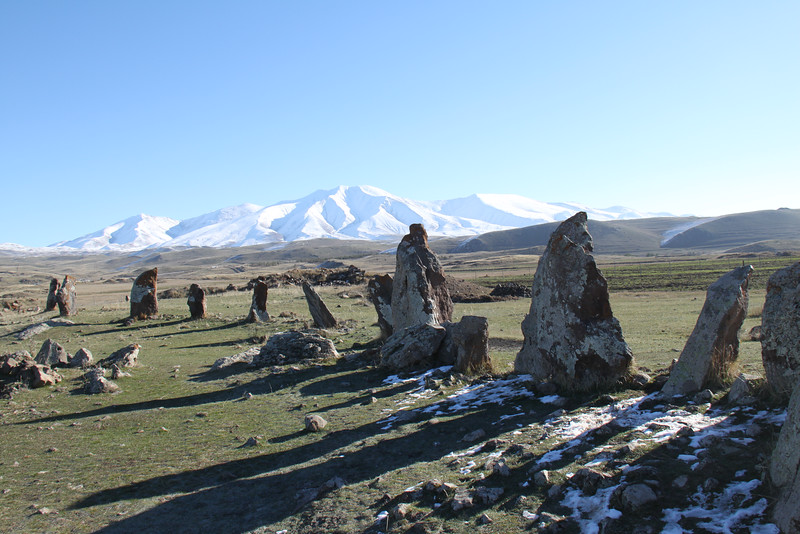
Driving slow on a stony dirt track across the rocky hills and then there was a section of deep muddy bog and I could see us stuck up to our axles in it, so I parked on top of the hill and we walked down a slope towards the stone circles. In the centre of a patch of sticky muddy ground, we passed a recently constructed rough stone hut with a metal door that had a sign “Information and Souvenirs” it was closed and uninviting. By now it was about 9 in the morning and still colder than a grave diggers arse. But the valley below in the shadow of the snow covered mountains was literally awesome and if before you didn’t believe in Yarweh or Bahama or Buddha then you sure as hell had to believe in something now. And the stone circles as we walked in on them were madder than a paisley shirt, every which way but a kind of order to them all at the same time. There were was a large stone circle with these kind of tentacles coming out from the centre. On the sign that was paid for by USAID (a gift from the American people) it said something about stones that talk and that maybe under them were buried fallen warriors. I did see some long ago looted tombs so who knows. And many of the stones had holes in them big enough to put your arm through. The sign said they were used to observe the galaxies and now because the galaxies have shifted or we have, the circle can be dated to between 7500 and 12,000 years old.

Stonehenge

I said to my mate who was visiting from Australia, “I wonder why they built it here?”

“Well they had to build it somewhere” he said

“So okay but why here?”

“Why not?”

And I look around and though we are high it seems we are also surrounded by mountains on all sides, but it was hardly a plateau.

So we wandered around being artistic. Taking pictures and making poses from behind rocks, on top of rocks, rocks in the foreground, the background, flanked by mountains, by sky, by other rocks. And it was icy, with snow on the peaks and white powder on the near hills.

As we wandered back there was loud stock car racer engine roar and this old while Russian Volga with a mismatched blue door wallowed through that bog like a battlefield tank, music blaring, it was rap but in that moment it sounded like the Star Wars theme.

They skidded to a halt at the end of the road where we were and then with only three cylinders firing and the muffler gone, much revving and wheels spinning they reversed up the steep little slope next to the Info centre. Three rangy youths in wool hats and hoodies out jumped and put rocks under the wheels to stop it rolling. I thought maybe they were shepherds or bandits or escaped convicts but it turns out they ran the Info Center and were building a chain mesh fence between the adjoining fields. I guess to separate this bit of rocky ground from the bit of rocky ground next to it. They offered us cans of iced coffee and we followed them up the treacherously uneven crazy paved stone steps into the center. Turns out one of them had worked with a famous German archeologist and knew a lot about Karahunj. Like it was constructed at least 2500 years before Stonehenge and that the word Hunj and Henge are very similar and Karahunj, Stonehenge and the Egyptian Pyramids form an equidistant triangle. Go figure that. And it turns out that just over the range is a field of prehistoric carved stones at a place called Navasar and they showed photos and graphics of a 7500 year old carving depicting two stick figures and a serpent a tree with one fruit in it, one of the stick figures had a prong between his legs and they told me that was Adam. They sold tee-shirts, postcards and other souvenirs with the carving on it. Makes you think too that the bible crosses a fair bit of territory. Also you have to admit that stones are pretty good at preserving history. Like 7500 years ago some guy who thinks the world is flat and doesn’t know where he is on it except he is on a hillside and he makes a rock carving of a story he heard somewhere. Then in 2014 someone in Armenia makes a tee-shirt out of it.

Posted in Postcards | Tagged , | Leave a comment

The Creator of Yerevan

Postcard from Yerevan

When I arrived in Yerevan I began to construct a new city; it is very similar to the Yerevan on my city tourist map and it is similar to the Yerevan of the people who have lived here all their lives. But this is the Yerevan of my creation. I have populated it with plane trees and nineteenth century buildings of grey basalt and pink limestone; with cobble stones and hidden courtyards spied through arched lane ways; and people in the street in their apparent boredom or beauty, each carrying with them their hopes and fears.

And me, making my way, new to this city, thinking about the opportunities I might have here to build a life and where I might live and how I might use this as a base to change the way we do development in this part of the world. I have also included the elderly white haired woman, long nosed and leather skinned in the seat on the bus beside me. I have made her a grandmother who has seen much happiness and much suffering under the Soviet time. And she has made her own Yerevan that is in many ways similar to the one I have created. But it is different; the streets in her Yerevan are longer and have more hazards; and the familiarity of the parks where she was courted as a young woman; and above the shop where over a dinner party in the home of her future parents in law her late husband proposed to her amid much laughter and happiness, for everyone had been waiting for that day.  And of the house where her daughter lives now with her grandchildren, and the house where her mother died; these landmarks will never be in my Yerevan. And this is a world she has constructed during her lifetime. And the young man on the seat opposite us, coming from university.  He has made a world that has very similar street layout to the old woman’s. But the streets are shorter and his landmarks are cafes where he and his friends meet; a lot of the detail of his Yerevan has yet to be completed as he only has thoughts now for the bus stop and the short walk up Mashtots Avenue, to the Retro Café and girl named Liana who he hopes will be there with his friends.

I see Mount Ararat, snow covered stark against the blue sky and the Mother Armenia statue watching over the city. But the elderly woman sees a Mt Ararat that is a reminder of the land where her grandparents died during the genocide and of stories of the trek her parents made from Van. Instead of Mother Armenia she sees the statue of Stalin who looked over the city from that same place before it was torn down in the early sixties. And I go on creating this Yerevan and take it into my soul, step by step, brick by brick as I wander through the streets of this city built nearly three thousand years ago. This Yerevan, that last year, it did not exist to me.

One way or another we are all creators of the universe we inhabit and somehow we are inclined to forget that each of us inhabits a different world of our own creation. At one level we know that people inhabit different worlds but at the same time we can still think that once they see our world, as we see it, they will leave their own and join ours and our way of seeing and inhabiting it.  And the folly of this is identified in the story above.

(Inspired by Vasily Grossman – An Armenian Sketchbook)

Posted in Postcards | Tagged , | Leave a comment

Gods Tears

Postcard from Yerevan

I was dining with a friend. She told me that three of her friends had been hit by a car at 3am crossing Tumanyan St last night. The road must have been deserted at that time, it has four lanes. But it happened.

She said the passenger in the Mercedes had died, no seat belt, thrown into the windscreen.

The three pedestrians will likely survive but have many broken bones and internal injuries

She was thoughtful.

Her phone rang; it was her friend, calling and upset because Travis was her friend too. In the early hours of this morning, they thought Travis would die. But she has learned that he will survive and is now being airlifted to the States but unlikely to return to Armenia.

She said that she realized again how fragile life is. I said “I think life is only a moment to moment thing, this very moment is all we have, this is all that is real, not the past moment, nor the moment to come, there is nothing more than this……… ever, how many times that repeats is in some ways meaningless. So death is just the end of these moments, nothing to worry about. ” She said that is beautiful. Inside this restaurant in the heart of Yerevan it was warm and the wine was good. Outside the rain was falling like Gods tears and in the street below the automatic wipers of a black BMW cleaned those tears off the windscreen in lazy efficient swipes.

April 2014

Posted in Postcards | Tagged , | Leave a comment

Of Swans and Wolves

d2068-swanlake2

Postcard from Yerevan

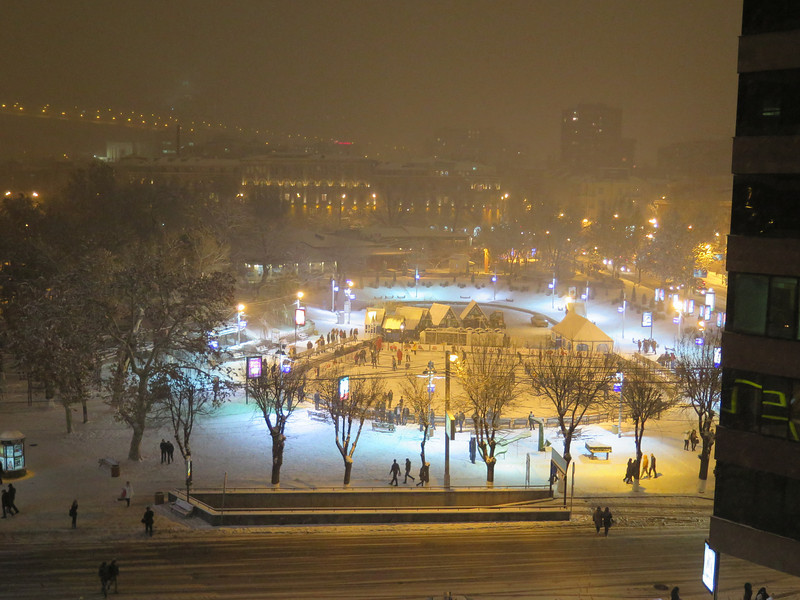
My fourth floor balcony in the center of Yerevan overlooks a small man-made lake. It is called Swan Lake and it is in the shape of Armenia. Up until recently the weather was mild and the lake had water in it. Sometimes the two swans swimming on it were white and at other times the two swans were black. I guess someone switched them every few days. Black swans are hot weather birds from Australia. Recently it began to get cold and I am imagining as it begins to snow, one black swan turns to the other; “what the frick was that?”

Now the lake has become an ice skating rink. The swans have gone and I watch the skaters doing ballet moves to Celine Dion’s Titanic song, loud through big speakers in the crisp air, ‘near far wherever we are, I believe that the heart does go o-on…”.

Today it is -5C, it started out this morning at -13C so it is warming up. My little electronic weather station also tells me that the humidity is -55%. What do you suppose that means?

Having a cup of tea on my balcony I noticed four council workers each carrying a life-size white plastic swan and apparently a map trying to figure out where to put them. I came out later to clear the used tea bag from the patio table and found it had frozen solid to the glass table top. That is a new experience for me.  I see the neighbor below puts bread on the table in the balcony below presumably to keep it frozen.

I have found this winter weather is fine if you dress for it. A few weeks ago I went to the outdoor market and in preparation for these days and bought a Russian fur hat. One of those hats you see people wearing in Moscow on -30 degree news reports. The Armenian man at the hat stand spoke no English and so we did miming interpretations of the various animals, he had hats made from rabbit, mink and other animals I couldn’t figure out from the miming.  I wanted something a bit exotic and ended up in buying one made from Wolf fur. Thinking I might be  part of some wolf extinction story,  with passer by translating, I asked him if the wolf was a problem in Russia or if it was somehow sustainably farmed for its skin He looked at me like I was completely mad and even with translation I was not able to get any kind of coherent picture except for, a wolf is a wolf you stupid man.

When I got home I checked on the internet and sure enough wolves are a problem in Russia. Recently 400 wolves got together in a super pack and surrounded a village and villagers had to mount snowmobile patrols while they waited for the army to arrive.  Apparently there is a high bounty paid for dead wolves and in Siberia the state has extended the hunting season on wolves to be all year round and on January 15 is officially beginning a “three month battle against wolves”. Anyway I bought the hat; it looks ridiculous but better than my ears shriveling up like dried Armenian apricots with frost bite.

Speaking of fur I noticed many bars in Yerevan have signs that read ‘fur bar’. I never went into any of them as I thought it might be the local term for pussy bar and that is not my thing. But now I know that the Armenian script for Bar looks like fur.

I still only know four things to say in Armenian; Barev dzez  – hello, barev luys – good morning,  lav em -how are you? And my newly mastered shnorhakalutyan – thank you.

Originally posted December 2013

Posted in Postcards | Tagged , | Leave a comment

Driving Armenia

cropped-img_0580-l1.jpg

The Road to Alaverdi

Postcard from Armenia

I can’t figure out all the features of my brand new fully optioned Suzuki S X Cross. The manual that came with it is in Russian, so the clock is still 20 minutes fast.  I need to burn some CDs because the radio only plays Armenian folk songs and Russian pop music. Until recently I have been getting around by taxi, old Russian Volgas that drive like tractors, or squeezing in to little boxy Ladas nicotine yellow on the ceiling vinyl. Most taxi drivers have more lucky charms bobbing about on their dashboards than a dancing witch doctor. Real rabbits feet,  or bits of fury skin that I am guessing are from a Yeti,  crucifixes, Turkish evil eyes hanging like grapes from key rings, little elephants with jewels on their head and pictures of saints and patriarchs, Jesus and Mary, hallelujah. And driving with them I know how they feel, you need all the road luck you can get here. So I have hung a rosary from my rear view mirror and stuck a little panel of Jesus, Mary and some orthodox patriarch on my dashboard. I trust in God but I also installed a  little camera which records every journey in case a  voodoo spangled vodka breathed taxi driver or rogue elephant  bus driver is feeling too lucky at my expense.I am thinking Armenian people often seem to be afraid of spaces. Like you can be sitting at a table with 6 people and everyone is talking, actually it sounded like arguing but I have learned this is just the Armenian way of very engaged conversation. And I look around and everyone, I mean all six of my friends are talking at once.  At first this was a mystery but then I surmised everyone was worried about leaving a space in the conversation that someone might move into, so they all moved in together.  And I have also noticed this in queues at the airport, if I leave a small space in front of me then someone will see that space and think that I don’t want it and move into it.  I am learning that the traffic works in a similar way.  If you leave a couple of car lengths between you and the car in front, someone moves in to fill the space. The effect of this is that about every 2 kilometers there is a rear end collision. You know because the cars have to stay in place on the road until the police get there and check things out. It all seems very civilized. When someone runs into the back of someone else, the drivers get out and shake hands, then when the police arrive they all shake hands again. I don’t know what happens after that, but I suspect that sooner or later I will find out first hand.There are many positives about driving here.  One incredibly civilized aspect is that traffic fines only cost between $12.50 and $25.00, a lot for locals but affordable for me. And there is a nine kilometer an hour grace on speed, so in a 50km an hour zone you can drive at 59 km per hour.  And the upside of people cutting in in front of you without warning is that you are graciously allowed to do whatever you like with or without indicators and it seems perfectly natural  and up to others to get out of your way. One slightly disconcerting driving trait is that most drivers seem to cut corners. So if you are on the inside lane you expect the drivers in the outer lane just to cut straight across in front of you, no fuss, no guilt, no indicators. It seems that one assumes this is expected and so to give way or beat them to the corner.  When you want to make a turn into incoming traffic you just inch forward to the point that other cars can no long swerve to miss you, in fact you are now blocking their lane and then you proceed with your turn as though getting out of their way is a favor to them.And then there is the joyful use of horns.  In the West a horn is often a questionable instrument. In the United States you use it in the wrong place someone in front may get out of the car in front and shoot you. In Australia they can be like some accessory that is too good to throw away but not much use.  But here they are used to express the full range of driving emotions. I have noticed that if one of my friends makes a particular unexpected veer into the lane of a trailing road user, they will react with a horn of distress from behind which is quickly followed by my fiends retaliatory horn to the road in front of us.  My use of horn is mainly directed towards buses the size of whales which pull out from the side of the road without any awareness of we smaller fish who just happen to be swimming past.I think the only really disconcerting aspect of driving here is that every so often one encounters an oligarch in a black, top of the range, BMW or Mercedes four wheel drive, with black tinted windows, gleaming chrome and sometimes a trailing body guard car. They are beating three lanes of bumper to bumper traffic by crossing the double lines and hurling themselves down the wrong side of the road into your path. I guess if they get stopped the fine is only $25.00 which is nothing if you have the wealth to live in something that looks like the Palace at Versailles and survive the drive. And it is the same at crossroads, it doesn’t matter about the rules of right of way, the oligarch in the black Hummer has the rule book that we all follow.  I am guessing there are a lot of lucky charms on their dashboards too.

IMG_0558-L

Posted in Postcards | Tagged | Leave a comment

The Salt of My Father

Postcard from Albania


Dad Catherine and Me

Me at 3, my sister Katie and my father Ian

I shake the salt container into my hand and sprinkle it onto the chips, I do this again and again as a reflex, watching the white sand in my palm and the unconscious motion of the sand to the chips. I think when did I start to do this in this way? And I remember it was what my father did, reluctant to let the shaker determine how much salt went onto the food. I remember as a six year old watching my father read the paper and eat breakfast toast. I watched through the window of the laminex top that was a kind of bench between the living room and the kitchen. My Dad ate the toast, read the paper and unconsciously ran his thumb across his fingers, with the skill of a pianist, to shed them of crumbs. And I thought when I am an adult this is what I will do. On the wall beside the laminex counter is a shadow box with blown glass birds and once my sister ran into me holding one and the sharp glass neck of a stork cut a long deep gash in my finger near the hand and  fifty years later I still have the scar. Like I still have the scar of my father’s strengths, my father’s weaknesses and his way of shaking salt.

But I am in Tirana Albania eating sword fish at a Greek restaurant and my father. long since dead, lives in me and in the way I use salt. He never traveled except to Thursday Island in the war where he waited for action which never came and caught sharks on big hooks and blew up reef fish with dynamite.

My father was a man who was honest in the world, he valued honesty, his name and his reputation for being a good man. And that is also the salt I look from him. While fearlessly honest in the world I don’t think he ever went deep with it within himself. I have tried to do both. He taught by his example of honesty and straightforwardness in the world and he taught me by his example of fear of self-examination. And I resolved to follow one and address the other.

I have done neither as well as I would have liked. I believe I am a calculating rather than a courageous man. I have been courageous at times when I have ventured into the unknown with communities I work with, not knowing whether I have the stuff to address a situation. But it is only them and me that will know if I have or I haven’t and maybe that is not such a risk.

When I was forty something,  I received the highest honor from the prestigious  private school I went to.There was one medal given each year to an alumni who had contributed greatly to the Australian society. So there I was in the company of the man who developed the world acclaimed bionic ear and several of what Australia calls its National Treasures. I was receiving my medal as the exemplar of that year in front of four thousand people and had thirty seconds to accept and say something. I started by acknowledging the indigenous people on whose land this auditorium  was built and more than implied that our White man success was only possible through their loss of county. This was like serving pork at a Jewish barbecue, and the school has never invited me back to speak to students. And this was brave, I knew it at the time, it was brave.

Posted in Postcards | Tagged | Leave a comment

Home is where you put your weight down

Postcard from Yerevan

Swan Lake Clear Night in Autumn

The View from my Balcony – Swan Lake in Autumn

I am stretching my legs with a walk up to the galley next to the toilets on the Fly Dubai plane on my way to Yerevan. Two men are chatting outside the service galley, look like soccer hoodlums to me but it turns out that they are missionaries from South Africa who come to Armenia each year to preach at a summer camp for young adults. Some kind of church to church support. As they tell me about their upcoming few weeks in the Armenia countryside. I am imagining a big tent with open sides and lots of people, singing and clapping and praying in tongues and saying how happy they are to be here and the people up the front saying how excited they are and using lots of words like majesty, savior  holiness, redeemer, justified, kingdom and more about personal and you than about others and us. Who knows, anyway I liked them and their commitment and if it wasn’t about Jesus and in another place these guys would likely be ready to blow themselves up for some Jihad somewhere.

It was a long flight, fifteen hours from Melbourne, seven more as a stopover in Dubai and then on to Armenia, my new home. At the luggage carrousel, I stand chatting with a suave Armenian guy named Karen, who is in his early thirties and looks like he has just been unfolded out of a shirt box. He lives in Dubai and sells luxury cigarettes for $30 a packet. I ask him if he smokes and he says no, neither does his boss. And then one of the mishos comes up to me and says that God has given him a prophesy about me, he bows his head and moves in close and I am pinned between him, Karen and a concrete pylon and I look up to see if there are any vines to Tarzan my way out. The mishos shinny bright eyes look knowingly at me; I guess he thinks I am looking to the heavens.  He says that the work I will do in the region will be much more impactful than I can possibly imagine and that the image he has is of an atomic bomb going off, it is so powerful. He is imagining grace, I am thinking self destruction. But for my first day here, seems like a good sign. Karen gives me his number and says lets hang out, I say why not.

Yerevan in summer is a dry heat 32C, wide pavements and big green lush tree lined streets, a city of parks and monuments and pillars with the bronze busts of poets and politicians of old grand Russian buildings and shopping. So many young women with shopping bags from the summer sales, the kind of girls who dress and laugh and walk intertwined arms and legs like sibling puppies and sway as they do in that kind of way that would make a bishop want to kick in a stained glass window. And there are churches here that go back to 300AD and now when they build new churches, they build them in the same shape and style as the old ones. If you are on a good thing you might as well stick with it for a thousand years or so. I think it is different where I come from, if you are on a good thing you tend to take it for granted and then grow unhappy and want to get rid of it, do a new design and make it bigger or smaller and more modern, more something. I wonder where modern comes from.

I have made new friends in the office, many people with names so different from any I am used to, like Armenuhi, Artak and Aramazd and surnames that are like some kind of scary Sudoku puzzle, Ghalamkaryan, Bezhanyan, Khaleyan and Saghatelyan. The good thing is all names seem to end in “yan” so I remember the first letter, and then mumble something and add yan at the end. Friends here are suggesting I learn Armenian, I am thinking I would rather be boiled in oil and I will be doing well if I can confidently get a few surnames right after a year. I do know two short phrases to get me out of trouble. “Problem cheeka” translates to “no worries” and “lave em” means “I am fine”. I am still working on “thankyou” which is pronounced “shnorhakalutyun”; seriously.

One of my friends here in the office told me a story about international development.

He says a man was traveling along a dirt road in a shiny Toyota Land cruiser, he is forced to stop as a large flock of sheep is blocking the road. The man gets out and walks over to the shepherd.

“If I tell you how many sheep you have, can I please take one for my research?”

The elderly shepherd nods in agreement.

The man from the car pulls out his Ipad, goes to a satellite App and after less than a minute says, “You have 353 sheep.”

The shepherd scratches the stubble on his chin and says, “If I tell you who you are, will you give me back my sheep?”

And the man from the car nods his agreement.

“You must be from USAID.”

“How did you know? Asks the man with the Ipad

Well I didn’t ask you to come here and you told me what I already know……… and now, will you please put down my sheep dog?

After an intensive search I found a two bedroom apartment right in the centre of Yerevan that will suit me well. The search itself was an adventure, with agents and agents of agents, sometimes five in a room speaking Armenian or Russian, one time I found myself mistakenly trying to do business with the guy driving the Mercedes, he turned out to be just the driver of the agent but he nodded a lot and seemed to like shaking my hand after each apartment viewing. Most apartments’ here are fully furnished. In Yerevan that means that every surface is covered by something, walls lined with grand cabinets and side dressers and little carts with little wagon wheels to put drinks on, paintings and chandeliers and mirrors. They find places to include some mirror in part of everything and if there is nothing to put mirror on in they just do straight mirror on the wall, size of a door. Like Louis the 14th meets Salvador Dali. I have been wondering what I am going to do with the 1800 kilos of furniture and personal possessions I shipped from Australia. I have found these things have a way of working themselves out but as yet I can’t see how this one will. Landlords here don’t want to take things out as they don’t know where to store them. My apartment is just round the corner from the Opera, which is one of the main landmarks in Yerevan. It was built in 1933 and has the Aram Khachaturian Concert hall at the back. Most people know Khachaturians Sabre Dance, it goes: DA DA DA DA DA DA DA DA DA DUH DA DA DA DUH DA DA DA DUH DA DA DA DUHDA DA DA DE DOODOO DOODOO DOODOO DOODOO WEEOO DEEOO WEEOO DA DA DA DA DA DA DA DA DA DUH DA DA DA DUH DA DA DA DUH DA DA DA DUHDA DA DA DE DOODOO DOODOO DOODOO DOODOO WEEOO DEEOO WEEOO BUM BUM BUM BUM BUM BUM BUM BUM,

I am going to the opera tomorrow night to hear Dmitri Hvorostovsky, who can forget his duet with Soprano Anna Netrebko in St Petersburg. I was lucky to get a ticket.

Swan lake skating

From my balcony: Swan lake, ice skating in winter


Posted in Postcards | Tagged , | Leave a comment

History and Me

Armenians being Marched by Turkish soldiers near Van 1915

Postcard from Yerevan

I stumbled on the rocky ground but managed to grab hold of the piping rail and pull myself up the grid iron steps to the rear landing of the carriage, just as the train picked up speed.  And it was only then that I saw Jane running towards the train along the track from the station. Alongside I helped her up and she said the men at the station had told her to wait until the train came back again from the siding. They took her to the Station Masters office and some of the men had tried to rape her. She wrestled herself free, jumped off the platform and ran.

That was over 30 years ago. Then the Shah was still in Iran, it was before the siege of the American embassy, before Gorbachev and Regan, the fall of the Berlin Wall, before the collapse of the Soviet Union, Bosnia, Rwanda and the genocides, before Bin Laden, Al Qaeda, 9/11 and falling men. Before the wars in Afghanistan and Iraq. Before mobile phones and laptops and IPods and 24 hour news. But we had seen lots of stretchered bodies in black and white on the nightly TV news in Vietnam and otherworldly kids with big eyed scull heads, pathetic skinny arms and dazed squatting women in cloth in Ethiopia in 73. And the camera usually showed some soldier with a bandage over his eye to be sent home or a starving woman in a tent with a bowl and made some comment like, “and these are the lucky ones”. I have noticed that reporters in tragic places still say this. It must be taught in journalism school. Or maybe we have a luck rescue gene in our unconscious that emerges to give us hope or let us off the hook.

Jane and I were backpacking from Australia across Asia to London. We had been gone over a year now. We went overland and through Afghanistan before the Russians had taken over militarily but there were signs of Russian influence everywhere. And in the summer of 79 in the Afghan countryside there were messy lines of men signing up for the army. Most young and some old with henna stained beards, turbaned and in baggy olive green, sand beige, kurta pyjamas, squatting in the precious shade of skinny poplar tree rows. We stayed a few days in Bamiyan north west of Kabul by the old silk road, within the high walls of a place that for centuries camel trains stopped for rest and supplies. We had stood atop the 50 metre high Buddha and taken in the valley below. Settlements of mud walled compounds joined together like a pencil maze and some like medieval forts. Small farms a few green trees stark against the beige and grey landscape. That was before the Taliban had blown these statues to rubble.

We took a bus to Herat and on to Tehran where we boarded the Lake Van Express, which in those days went all the way to Istanbul. The trip was 4 days and in Turkey at Van on the eastern shore of Lake Van the carriages were shunted in to the bowels of a ship. The crossing took four hours then the carriages were hitched to locomotive on the western side for the remaining 2 days to Istanbul. It was just before the locomotive re-coupled that Jane needed to go to the toilet and so she was still on the ship when the carriages were connected and hauled a mile up the line. And me not thinking that the train was actually going back jumped off rather than leave Jane and I only barely managed to clamber back on when it finally reached the switch point and reversed back to Tatvan station.

But then I knew nothing of Van and its dreadful history or that the fathers of the men who had tried to rape Jane would likely have lived there when the killing of tens of thousands of Armenians living on the wrong side of a line drawn by colonial interests. And in 1915 Orders out of the fearful minds of Jevdet Bey the Governor of Van and Enver Pasha the Minister for the Ottoman Army, lead to the Armenians who had lived here for 1000 years being butchered and driven on death marches while the soldiers took their valuables and neighbours stole their houses. And those who somehow survived became refugees in Syria, Lebanon, and to every corner of the world. All together around 600,000 Armenians were slaughtered outright and a further 400,000 women, children, elderly and infirm died on the death marches to the Syrian Desert. Over 150,000 Armenian children became orphans. In the USA, France and England there were some who wrote about what was happening but nothing was done. And the Turks have never admitted their part so to this day there is little healing on either side. Hardly a family in Armenia didn’t suffer loss.

I went to the Genocide Memorial in Yerevan and the most moving thing for me was walking through the fir trees planted before the museum itself. The haunting music of the duduk, a reed flute carved from an apricot branch is piped through these trees and it reaches into you like the plea of a child, audible tears of the heart.   Yesterday during some prayers at a work retreat and thinking about our world, we sang the following song as a wake.

“If the war goes on
and the children die of hunger,
and the old men weep
for the young men are no more,
and the women learn
how to dance without a partner
who will keep the score?

If the war goes on
and the truth is taken hostage;
and new terrors lead
to the need to euphemise,
when the calls for peace
are declared unpatriotic,
who’ll expose the lies?

If the war goes on
and the daily bread is terror,
and the voiceless poor
take the road as refugees;
when a nation’s pride
destines millions to be homeless,
who will heed their pleas?

If the war goes on
and the rich increase their fortunes
and the arms sales soar
as new weapons are displayed,
when a fertile field
turns to-no-man’s-land tomorrow,
who’ll approve such trade?

If the war goes on
will we close the doors to heaven,
if the war goes on,
will we breach the gates of hell;
if the war goes on,
will we ever be forgiven,
if the war goes on…. “
[1]
The pastor said afterwards; let’s just take a few minutes to cry. I felt the Armenian genocide like a wound. That song is true of this genocide and it speaks true to Afghanistan and Iraq as it does to the 13 shot dead in Washington while I was there last week and the deaths yesterday at the Westland Mall in Nairobi, where I have often been on other Saturday afternoons to see a movie.

Much of the Armenian countryside is rugged and parched dry in summer, steep stony mountains and wretched twisted trees and brittle bushes hanging on for life. Some friends and I drove to the Geghard Monastery built in the 4th Century and once housing the spear that lanced Jesus on the cross. The road wound its way through little villages, green oasis, filled with fruit trees and every kind of vegetable which are for sale on the roadside stalls. Elderly woman sit beside trestle tables stacked with jars of all sizes filled with pickled fruits and vegetables all colours and shapes. And my friends fiancé says that I should never buy pickled goods from the road side stalls, as there are frequent outbreaks of salmonella poisoning and as she said, “whole families has been massacred by the pickled vegetables and all ended up dead”.

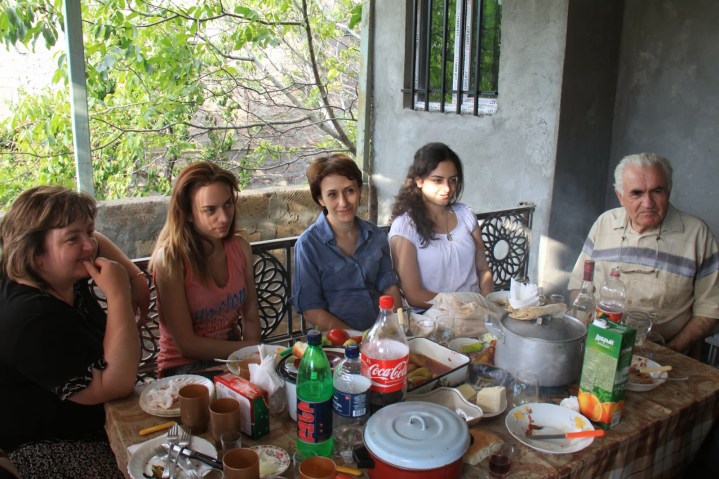
One Saturday afternoon I sat with my friend Suren’s extended  Armenian family around a table of local food all prepared on the table we ate at or from the wood barbecue in the garden amongst the fruit trees. I avoided several dishes lest I too be massacred by a pickled vegetable. My friend’s father, he no English and me with no Russian or Armenian, toasted each other and the family with the 62% Cognac he had made from the apricots of the trees in the garden under the balcony on which we now sat. He instructed that with each toast and there were many, I take the shot glass full, swallow it in one and hold my breath. The warmth of the alcohol and the essence of the apricot were like shots of apricot sunshine. And then he told me he would sing. He said there are only seven songs in Armenia and they are all about honey and bears. Then starting low and in the tones of a lullaby he began to sing. I recorded it and later asked a friend to translate and the words are:

A kind, faithful and virtuous friend

Makes one shine like the sun

If you have a faithful friend by your side

You will pass through darkness like in the daylight

Even if you sacrifice your life to a friend it will not be enough

A true friend is just like a torch and will always help you to go up the stairs of life

When attacked by enemies, a brave friend is like a sword of protection

If you have a close friend you will never feel old.

I feel it such a privilege to be here, doing something I believe in with people who believe in me. And I think this is really at the heart of human development; believing it is possible that something can be done to make our lives better and believing in each other to make that difference come alive. I am thinking that my work in local economic development is as much about finding new ways to be friends as anything else.


Lunch on Suren’s balcolny

1 Words & music John L. Bell & Graham Maule, music John L. Bell, copyright @ 1999, 2001, 2002 WGRG, Iona Community Glasgow G2 3DH, Scotland.

(Yerevan September 2013)

Posted in Postcards | Tagged , , , | Leave a comment